Rajasthan High Court Mandates Soft Skills Training for Police; Coordination Committees to Address Advocate-Police Misconduct, Court intervenes following incident of police misbehavior towards advocates; Calls for mutual respect and improved coordination within the justice system.
In a significant development, the Rajasthan High Court has directed the implementation of soft skills training for police personnel following an incident of alleged misbehavior by police officials towards advocates in Jodhpur. The court has also ordered the establishment of Coordination Committees at the district level to address grievances and promote a harmonious working relationship between advocates and police personnel.
The incident, which has sparked widespread concern within the legal community, involved the manhandling of a lawyer and his wife, both practicing advocates, at the Kudi Bhagtasani Police Station in Jodhpur. The couple, who had accompanied a rape victim to the station, were allegedly mistreated by the Station House Officer (SHO) and other officials. A video of the incident has gone viral, prompting immediate judicial intervention.
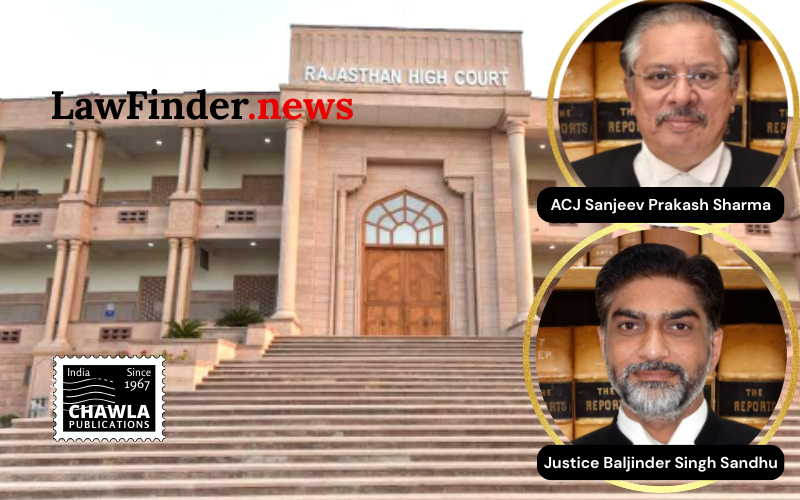
The division bench, comprising Mr. Sanjeev Prakash Sharma, A.C.J., and Mr. Baljinder Singh Sandhu, J., took up the matter and called upon senior police officials, including the Commissioner of Police, Jodhpur, to appear in court. Acknowledging the severity of the incident, the court emphasized the need for police to handle interactions with advocates with the utmost professionalism and courtesy.
The High Court underscored the integral role both advocates and police play in the justice delivery system, advocating for mutual respect and cooperation. The court highlighted the necessity for police officers to receive comprehensive training in soft skills to prevent such incidents in the future. It was also noted that the Commissioner of Police assured the court of conducting an inquiry and initiating departmental proceedings against those responsible.
In addition to addressing this particular incident, the court revisited a prior directive from a 2019 case, which called for the formation of Coordination Committees at the district level to resolve issues between the legal and law enforcement communities. These committees are to be chaired by a District Judge or a retired High Court Judge and will include representatives from the Bar Association, judiciary, and police department. The court has mandated that the details of these committees be reported back to the court.
The Rajasthan High Court's proactive stance in addressing this issue is seen as a crucial step towards ensuring a fair and respectful interaction between advocates and police. The legal community has welcomed the court's directives, hoping that these measures will prevent future conflicts and foster a more collaborative environment.
Bottom Line:
Advocates and police personnel, as integral parts of the justice delivery system, must maintain mutual respect and cooperation. Incidents of misbehavior by police officials towards advocates necessitate soft skills training for police personnel and the establishment of Coordination Committees at district levels for grievance redressal.
Statutory provision(s): No specific statutory provisions are cited in the judgment. The directives are based on judicial observations and previous case references related to advocate-police interactions.