New Delhi, May 15 Observing that nature of an offence cannot be the sole ground for denying remission, the Supreme Court on Friday allowed a plea seeking premature release of one of the convicts in the 2003 murder case of 26-year-old poet Madhumita Shukla.
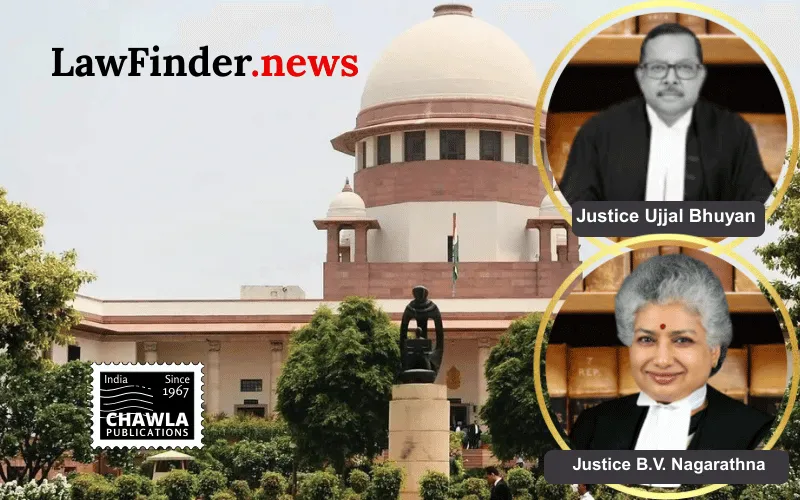
A bench of justices B V Nagarathna and Ujjal Bhuyan set aside the order of the Ministry of Home Affairs dated July 9, 2025, rejecting the Uttarakhand government's recommendation for premature release of convict Rohit Chaturvedi.
The top court noted that Chaturvedi has spent 22 years in jail without remission.
"Crime is one thing, reformation is different. The focus of the State should be reformation, not retribution," the bench observed while reading the judgement.
"We have no hesitation to hold that the impugned letter dated July 9, 2025 of MHA which rejected the recommendation of the State of Uttarakhand and disallowed the plea of premature release of the petitioner is arbitrary, non-speaking, unsustainable in law and merit and is therefore set aside and quashed," the bench said.
Noting that MHA has passed a "non-speaking and cryptic" order, the apex court said any order affecting rights of a person and particularly his liberty must be with reasons and must reflect due application of mind.
"Recording of reasons is not an empty formality, it is a safeguard against arbitrariness and ensures transparency, fairness, and accountability in decision making. The absence of reasons renders it bald and makes it impossible to ascertain whether relevant factors were duly considered or not," the bench said.
The apex court said executive discretion, though broad in matters of remission, is not "uncanalised" and must necessarily be exercised on relevant rational, and non-discriminatory considerations.
The bench said in a constitutional polity governed by the rule of law, the denial of remission cannot rest solely on the ground of heinousness of the crime.
"Remission is not an extension of the sentencing process, but a distinct executive function concerned with the present and future, namely, the prisoner's conduct, evidence of reformation, and prospects of reintegration into society.
"To predicate its denial only on the heinous nature of the offence is to collapse this distinction and to reconvert remission into a retrospective reaffirmation of guilt, which the criminal justice system has already adjudicated upon," the bench said.
The top court said a criminal justice system that refuses to look beyond the gravity of the offence to the offender's transformation will betray its reformative ideal particularly at the remission stage.
Justice does not permit permanent incarceration of an individual in the shadow of their worst act, it said.
Commenting that the nature of the offence cannot be the sole ground for denying remission, the bench said emotive retribution is a course, incompatible with constitutional values.
"The decision on remission must emerge from a holistic assessment of the prisoner and after balancing societal interests with the prisoner's right to be considered for release on fair and reasonable criteria.
"As Plato, the Greek scholar and philosopher, said any means, of word or deed, privilege or deprivation, that can be used to make the unjust man or the criminal, hate injustice and avoid recidivism are to be employed," it said.
The apex court said deprivation of liberty no longer serves correction but becomes retribution.
"In a liberal constitutional order, punishment and all its incidents, including remission, must necessarily be justified through reason and not outrage," it said.
The apex court noted that Chaturvedi is already out on bail and need not surrender.
Shukla was shot dead on May 9, 2003, in Lucknow's Paper Mill Colony while she was pregnant. Former Uttar Pradesh minister Amarmani Tripathi was arrested in September 2003 in connection with the killing of the poet, with whom he was allegedly in a relationship.
Subsequently, other accused were also arrested in connection with a conspiracy to kill Shukla.
On October 24, 2007, a trial court in Uttarakhand convicted Tripathi, his wife Madhumani, his nephew Rohit Chaturvedi and his associate Santosh Kumar Rai for Shukla's murder and sentenced them to life imprisonment.
Chaturvedi, who was convicted of criminal conspiracy and murder, had applied for premature release to the Uttarakhand government.