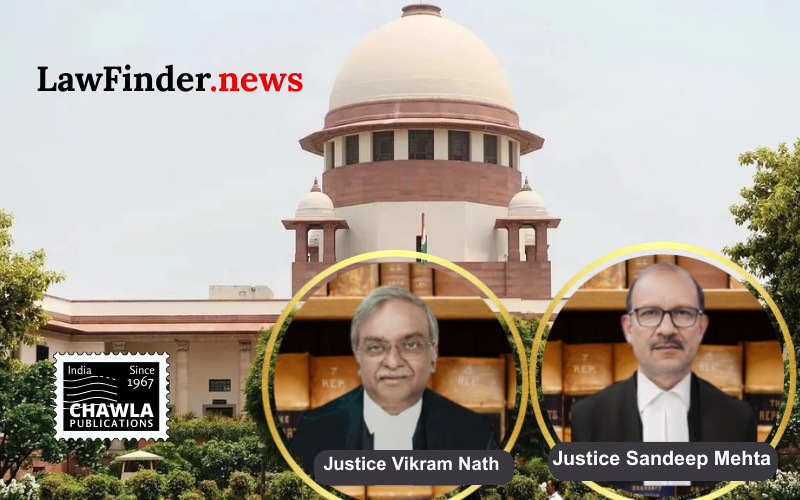
Supreme Court Overturns High Court Ruling on Multi-State Cooperative Society Status. Apex Court Clarifies the Scope of Section 103 of Multi-State Cooperative Societies Act, 2002
In a significant judgment, the Supreme Court of India has overturned a decision by the Allahabad High Court regarding the status of a cooperative society following state reorganization. The case, titled "State of Uttar Pradesh v. Milkiyat Singh," revolved around the applicability of Section 103 of the Multi-State Cooperative Societies Act, 2002. The Supreme Court ruled that Section 103 does not automatically confer multi-state status on a cooperative society simply because the parent state has undergone reorganization.
The case involved a cooperative sugar factory, Kisan Cooperative Sugar Factory Limited, originally registered under the Uttar Pradesh Cooperative Societies Act. Following the bifurcation of Uttar Pradesh into the states of Uttar Pradesh and Uttarakhand, a legal question arose whether the society should be deemed a multi-state cooperative society under the Central Act.
The Allahabad High Court had previously ruled in favor of the writ petitioners, who argued that the society had acquired multi-state status post-reorganization, thus placing it under the jurisdiction of the Central Act. However, the Supreme Court, led by Justices Vikram Nath and Sandeep Mehta, found that such a transformation requires a factual inquiry into whether the society's objects extend beyond one state.
The Court emphasized that Section 103 requires a careful examination of the society's objectives as stated in its bye-laws, rather than its area of operation. The judgment clarified that the mere geographical reach of the society's operations does not suffice to convert it into a multi-state entity. The Supreme Court's decision reinstates the authority of the State Act over the sugar factory, dismissing the High Court's interpretation that had favored the petitioners' claim.
This ruling provides clarity on the legal framework governing cooperative societies in India, particularly in the context of state reorganizations. It underscores the necessity of assessing a society's stated objectives rather than its operational geography when determining its legal status. The Supreme Court's verdict reinstates the original status of the cooperative sugar factory under the Uttar Pradesh Cooperative Societies Act.
Bottom Line:
The applicability of Section 103 of the Multi-State Cooperative Societies Act, 2002, depends on a factual enquiry as to whether the objects of the cooperative society extend to more than one State.
Statutory provision(s): Multi-State Cooperative Societies Act, 2002 Sections 5, 103
State of Uttar Pradesh v. Milkiyat Singh, (SC) : Law Finder Doc Id # 2822120