Supreme Court Upholds Rights of Disabled Woman, Orders Coal India to Create Supernumerary Post In a landmark judgment, the Supreme Court mandates employment for a visually impaired woman, emphasizing the need for reasonable accommodation and substantive equality under the Rights of Persons with Disabilities Act, 2016.
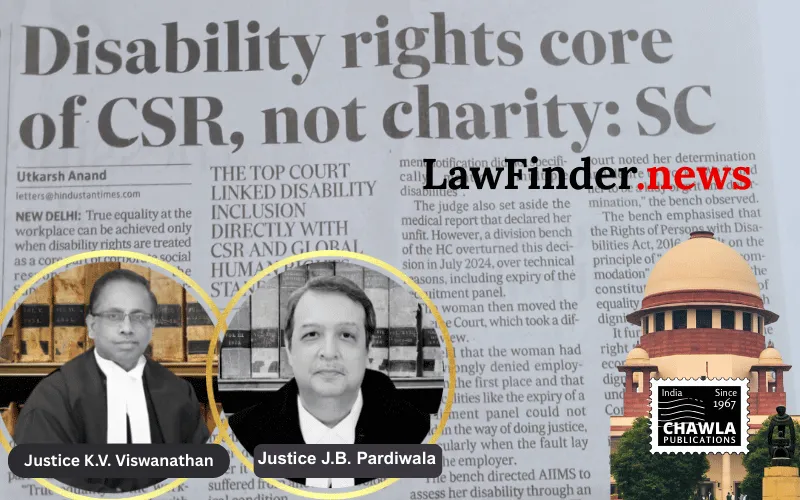
In a significant ruling, the Supreme Court of India has directed Coal India Limited to create a supernumerary post for Sujata Bora, a visually impaired woman with multiple disabilities, underscoring the importance of reasonable accommodation and substantive equality under the Rights of Persons with Disabilities Act, 2016. The judgment, delivered by Justices J.B. Pardiwala and K.V. Viswanathan, emphasized that technicalities such as the expiry of a recruitment panel cannot justify the denial of employment to persons with benchmark disabilities.
The case originated from a 2019 recruitment process by Coal India Limited for Management Trainees, where Sujata Bora applied under the visually handicapped category. Despite being initially selected, she was later declared unfit due to additional health conditions. This led to a legal battle, culminating in the Supreme Court's intervention after a division bench of the Calcutta High Court overturned a single judge's decision in her favor.
The apex court, after reviewing medical assessments from the All India Institute of Medical Sciences (AIIMS), confirmed Bora's disability exceeded the benchmark level. The court criticized the rigid adherence to procedural technicalities by Coal India, which had previously denied Bora employment due to the expiry of the recruitment panel.
In a detailed judgment, the Supreme Court elaborated on the concept of "reasonable accommodation," a fundamental right under the RPwD Act rooted in the constitutional principles of equality and dignity. The court highlighted the necessity for public sector undertakings to adopt inclusive policies that accommodate the unique challenges faced by individuals with disabilities, particularly when intersected with other forms of discrimination such as gender.
Recognizing the compounded disadvantages faced by women with disabilities, the court called for an intersectional approach to ensure substantive equality. It also underscored the corporate responsibility of public sector undertakings like Coal India to integrate disability rights within their employment practices, aligning with global standards of corporate social responsibility.
The court further directed that Bora be provided with a suitable desk job equipped with specialized tools to accommodate her disabilities, emphasizing the right to work as an essential liberty. This decision not only provides immediate relief to Bora but also sets a precedent for future cases involving employment rights of disabled individuals.
The judgment reflects the judiciary's commitment to bridging the gap between constitutional ideals and the lived realities of marginalized communities. It highlights the need for a holistic approach in addressing the unique challenges faced by persons with disabilities, ensuring their full and effective participation in society.
Bottom Line:
Rights of Persons with Disabilities Act, 2016 - Denial of employment to a person with benchmark disability due to technicalities like the expiry of recruitment panel held to be unjustified. Reasonable accommodation and substantive equality must be ensured for persons with disabilities.
Statutory provision(s): Rights of Persons with Disabilities Act, 2016, Constitution of India Articles 14, 21, 41, Article 142.
Sujata Bora v. Coal India Limited, (SC) : Law Finder Doc Id # 2837400