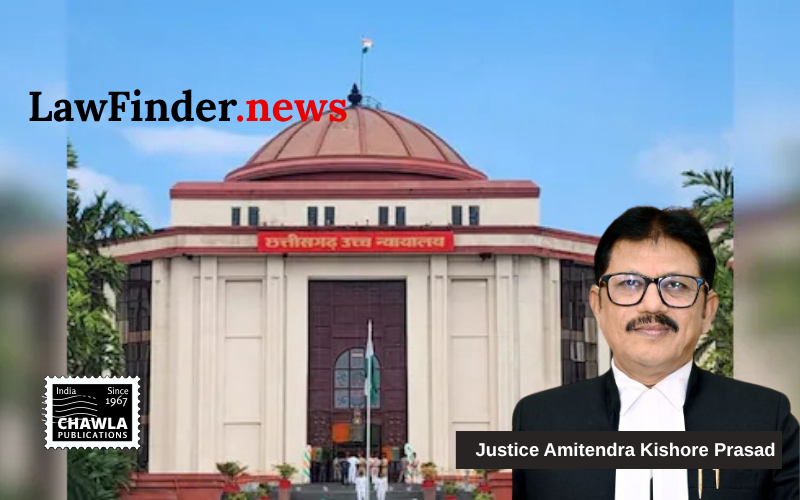
Chhattisgarh High Court Upholds Succession Certificate Issuance to Father-in-Law, Clarifies Role of Nominee in Bank Accounts Court reinforces that nominees are custodians, not owners, of assets under Indian Succession Act, 1925
In a significant ruling, the Chhattisgarh High Court, presided by Justice Amitendra Kishore Prasad, upheld the issuance of a succession certificate to Lalla Ram, the father-in-law of the deceased Ranjana Devi Pradhan, concerning her bank deposits amounting to Rs. 15,00,000. The judgment clarified the legal standing of nominees under the Indian Succession Act, 1925, reiterating that nominees act as custodians rather than owners of the deceased's assets.
The case arose when Lalla Ram sought a succession certificate to claim the funds in Ranjana Devi Pradhan's account post her demise. The initial trial court had awarded the funds to the nominee, Rahul Kumar Dhruve, a decision which was overturned on appeal. The appellate court ruled that nomination does not override the laws of succession, and as Ranjana Devi Pradhan's father-in-law, Lalla Ram was deemed the rightful heir under Section 15(1)(b) of the Hindu Succession Act, 1956.
The court emphasized that the nominee's role is to safeguard the estate until the rightful heirs can claim it. The decision aligns with previous Supreme Court judgments, including Sarbati Devi v. Usha Devi, which declared that nomination does not confer ownership, but merely grants the nominee the authority to manage the assets temporarily.
This ruling is pivotal in clarifying misconceptions regarding the rights of nominees in the context of succession and inheritance under Indian law. The court's decision ensures that the estate of the deceased is distributed as per the lawful succession plan, preserving the rights of legitimate heirs over nominees.
Bottom Line:
Nominee under a bank account does not acquire ownership rights over the funds; they act as mere custodians of the property, and the rightful heirs as per succession laws are entitled to inherit the property.
Statutory provision(s): Indian Succession Act, 1925, Section 372; Hindu Succession Act, 1956, Section 15(1)(b)
Rahul Kumar Dhruve v. Public General Nil, (Chhattisgarh) : Law Finder Doc Id # 2810835