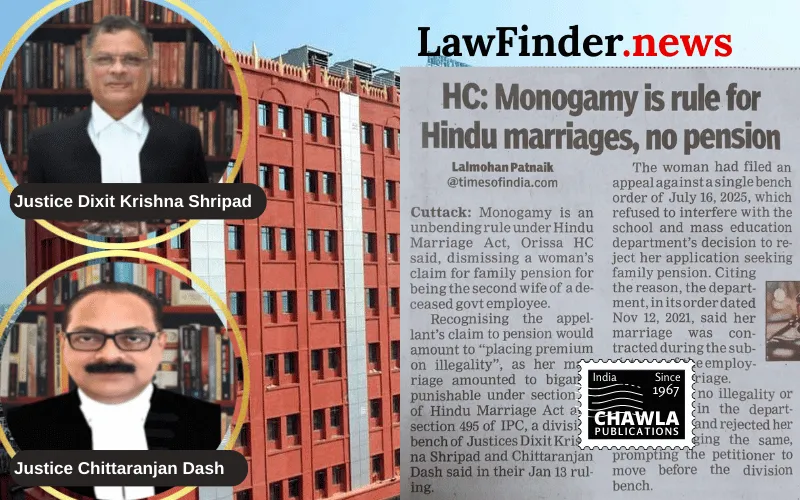
Court affirms that second marriages during the subsistence of the first are void under Hindu Marriage Act, 1955, disqualifying the second wife from pension claims.
The Orissa High Court, in a significant ruling dated January 13, 2026, dismissed the appeal of Kankalata Dwibedi, who challenged the denial of her claim for family pension following the death of her husband, Late Niranjan Dwibedy. The Division Bench, comprising Justices Dixit Krishna Shripad and Chittaranjan Dash, held that the second marriage, contracted during the lifetime of the first wife, is void under the Hindu Marriage Act, 1955, thereby disentitling the appellant from claiming the pension.
The appellant contended that the Odisha Civil Services (Pension) Rules, 1992, which use the term 'wife'/'wives', entitled her to the pension after the demise of the first wife. However, the court rejected this argument, emphasizing that the term 'wives' does not validate polygamy or confer rights under a void marriage.
The court underscored the principle of monogamy enshrined in the Hindu Marriage Act, 1955, where any second marriage during the subsistence of the first marriage is deemed void and constitutes the offence of bigamy, punishable under Section 17 of the Act read with Sections 494 and 495 of the Indian Penal Code.
The bench further stated that the term 'wife' in pension rules presupposes a legally valid marriage, and the pension cannot be awarded based on an illegal relationship. The judgment reinforces the legal stance that void marriages cannot be legitimized posthumously by the death of the first spouse.
Citing precedents, the court referred to various judgments, including the Supreme Court's stance in Raj Kumari v. Krishna and the Karnataka High Court's decision in Mahalakshmamma v. The Secretary, which uphold the legal prohibition on bigamy and deny benefits derived from void marriages.
This judgment serves as a reminder of the legal framework governing marriages and pensions, affirming that statutory benefits cannot be extended to relationships not recognized by law.
Bottom Line:
Family pension cannot be claimed by the second wife of a deceased employee when the second marriage was solemnized during the subsistence of the first marriage, as such a marriage is void under the Hindu Marriage Act, 1955, and constitutes the offence of bigamy.
Statutory provision(s): Hindu Marriage Act, 1955 Section 17, Indian Penal Code Sections 494, 495, Evidence Act, 1872 Section 114
Kankalata Dwibedi v. State of Odisha, (Orissa)(DB) : Law Finder Doc Id # 2838788