Supreme Court Reinforces Limitations on Judicial Interference in Panchayat Elections, Supreme Court Sets Aside Uttarakhand High Court's Order Allowing Disqualified Candidate to Contest Panchayat Elections
In a landmark judgment, the Supreme Court of India has reaffirmed the constitutional limitations on judicial interference in Panchayat elections, underscoring the importance of statutory remedies. The apex court set aside an interim order by the Uttarakhand High Court that had allowed a disqualified candidate, Narendra Singh Deopa, to contest the election for the office of Zila Panchayat Member, despite his nomination being rejected by the Election Officer.
The case arose when the Uttarakhand State Election Commission resumed Panchayat elections, and Deopa's nomination was rejected due to alleged non-disclosures. The High Court, in an interim order, permitted Deopa to participate in the elections, a decision that was subsequently challenged by Sandeep Singh Bora, the appellant who had been declared elected unopposed.
In its judgment, the Supreme Court emphasized that Article 243-O of the Constitution of India explicitly bars judicial interference in Panchayat elections except through an election petition, as provided under the relevant state legislation. The court noted that the Uttarakhand Panchayati Raj Act, 2016, offers a comprehensive mechanism for addressing election disputes, which Deopa should have pursued instead of seeking recourse through a writ petition.
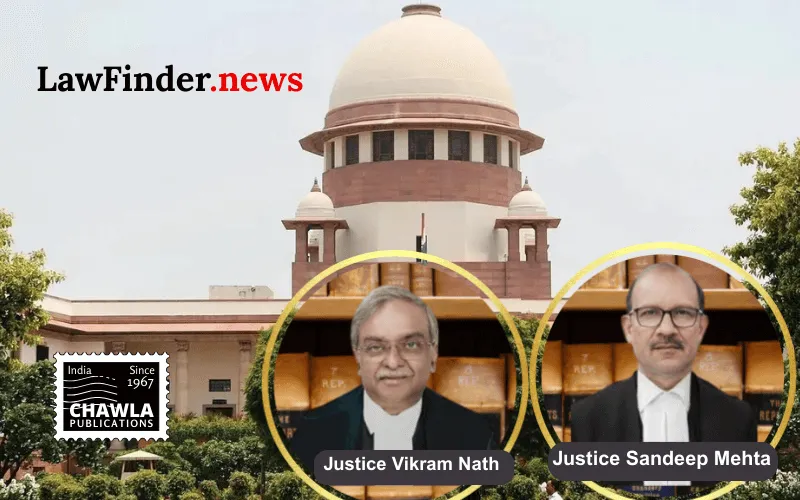
Justice Vikram Nath, delivering the judgment, highlighted that the High Court's intervention contradicted the constitutional mandate and disrupted the electoral process that had attained finality. The court further elaborated that individual grievances should not stall the electoral process, emphasizing the necessity of adhering to statutory remedies for election-related disputes.
The Supreme Court's decision underscores the judiciary's cautious approach in election matters, prioritizing statutory mechanisms over extraordinary jurisdiction under Article 226 of the Constitution. This ruling reinforces the significance of statutory frameworks in maintaining the integrity and smooth conduct of elections, ensuring that individual grievances do not impede the democratic process.
Bottom Line:
Bar under Article 243-O of the Constitution precludes judicial interference in Panchayat election matters except through an election petition. High Court cannot invoke Article 226 jurisdiction to interfere with the electoral process when statutory remedies are available.
Statutory provision(s): Article 243-O of the Constitution of India, Article 226 of the Constitution of India, Section 131H of the Uttarakhand Panchayati Raj Act, 2016
Sandeep Singh Bora v. Narendra Singh Deopa, (SC) : Law Finder Doc id # 2847556