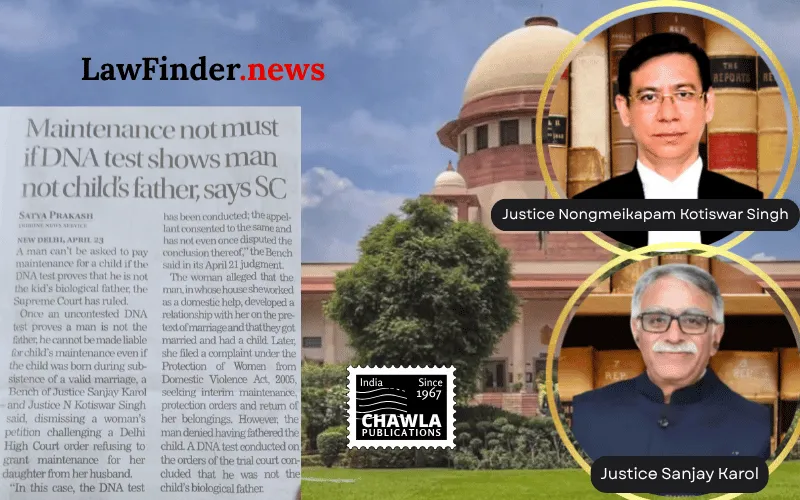
Supreme Court Upholds DNA Test Results Over Legal Presumptions in Paternity Dispute, Supreme Court affirms High Court's decision denying child maintenance based on DNA evidence, highlights precedence of scientific evidence over legal presumptions.
In a landmark ruling, the Supreme Court of India has upheld the decision of the Delhi High Court, which denied maintenance to a child based on DNA test results that conclusively disproved the alleged father's paternity. The judgment was delivered in the case of Nikhat Parveen @ Khusboo Khatoon v. Rafique@shillu, highlighting the precedence of scientific evidence over legal presumptions of legitimacy under the Indian Evidence Act, 1872.
The case revolves around an appeal filed by Nikhat Parveen, the appellant, challenging the High Court's decision that her daughter was not entitled to maintenance from Rafique, the respondent, based on a DNA test that indicated he was not the biological father. The Court's decision was informed by the provisions of Section 112 of the Indian Evidence Act, which presumes the legitimacy of a child born during a valid marriage unless disproved by evidence such as a DNA test.
The appellant, who had been employed as domestic help at the respondent's residence, alleged that Rafique had established a sexual relationship with her under the pretense of marriage. They eventually married in March 2016, and the child in question was born in April 2016. However, matrimonial relations soured, leading to a complaint under the Protection of Women from Domestic Violence Act, 2005, seeking maintenance and protection.
The Metropolitan Magistrate's Court and subsequently the District and Sessions Judge, Saket Court, had earlier denied maintenance based on the DNA test results. The Supreme Court, concurring with the High Court's detailed examination of the legal presumption of legitimacy, noted that the DNA test results, having attained finality, rebutted the presumption under Section 112.
The judgment emphasized the evolving judicial stance that scientific evidence, when final and undisputed, must prevail over legal presumptions. Citing previous Supreme Court cases, the judgment reiterated that while the presumption of legitimacy aims to protect children from the stigma of illegitimacy, the truth, when scientifically proven, cannot be ignored.
In a compassionate gesture, the Supreme Court directed the Secretary, Women and Child Development, Government of NCT of Delhi, to ensure the well-being of the child. The Court ordered an assessment of the child's living conditions and mandated remedial measures to provide support in terms of education, nutrition, and health.
This ruling not only marks a significant development in the interplay between legal presumptions and scientific evidence but also underscores the judiciary's commitment to child welfare and upholding truth and justice.
Bottom Line:
Presumption of legitimacy of child born during marriage - DNA test results can override the presumption under Section 112 if the DNA test has attained finality and conclusively disproves paternity.
Statutory provision(s): Indian Evidence Act, 1872, Section 112; Protection of Women From Domestic Violence Act, 2005, Section 12
Nikhat Parveen @ Khusboo Khatoon v. Rafique@shillu, (SC) : Law Finder Doc id # 2886355