Supreme Court Upholds Bail for Accused in Panchayat Chairman Murder Case Supreme Court affirms High Court's discretion, citing lack of misuse of bail and long incarceration period.
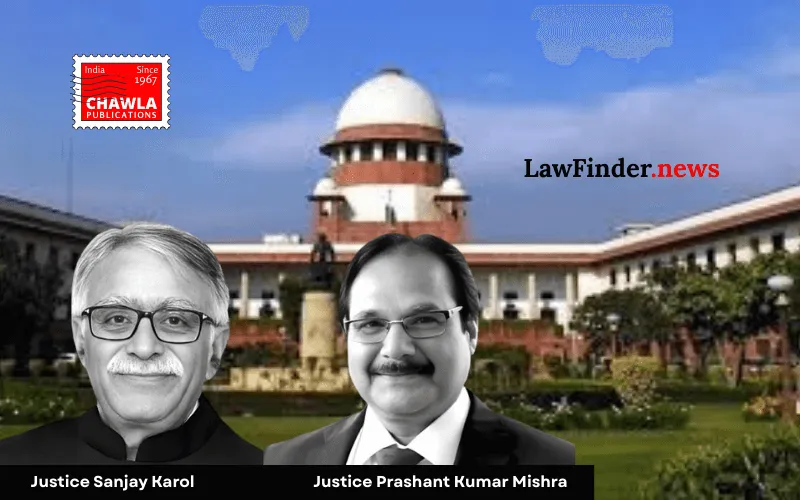
In a significant decision, the Supreme Court of India has dismissed an appeal challenging the grant of bail to Rinku Bhardwaj alias Prakash Rajbhar, who is accused in the high-profile murder case of a Panchayat Chairman in Uttar Pradesh. The bench comprising Justices Prashant Kumar Mishra and Sanjay Karol upheld the Allahabad High Court’s decision, emphasizing the principles governing the cancellation of bail.
The Supreme Court reiterated that the cancellation of bail already granted requires exceptional circumstances such as interference with justice, evasion of justice, or abuse of liberty. The bench noted that mere long incarceration or parity with co-accused is insufficient for bail cancellation unless there is evidence of misuse of liberty.
The case dates back to an incident on October 25, 2018, when the deceased was shot during his morning exercise in Sonbhadra district. Although Bhardwaj was not named in the initial FIR, he was later arrested based on the oral dying declaration of the deceased and a disclosure statement by a co-accused. The accused has been in jail for over six and a half years.
The appellant argued that Bhardwaj, described as a notorious criminal, had orchestrated the murder using automatic weapons and was arrested after a joint operation by the Special Task Force and Anti-Terror Squad. However, the Supreme Court found no cogent reasons to interfere with the High Court's discretion, noting that the accused had not misused his bail since being released.
The bench referenced previous judgments, including Mahipal v. Rajesh Kumar and Dolat Ram v. State of Haryana, to underline the strict criteria for bail cancellation. It stressed that bail decisions should balance public interest in justice administration with individual liberty protection, and should not be set aside without clear evidence of impropriety.
The Supreme Court's decision underscores the judiciary's commitment to upholding legal principles in bail matters, ensuring that liberty is not curtailed without substantial justification. The case highlights the complexities involved in balancing justice administration with individual rights, a cornerstone of the Indian legal system.
Bottom Line:
Cancellation of bail - Exceptional circumstances required for cancellation of bail already granted, and the discretion exercised by the High Court should not be interfered with unless there is misuse of liberty or cogent reasons to do so.
Statutory provision(s): Sections 147, 148, 149, 302, 120B, 34 of the Indian Penal Code, 1860, Section 7 of the Criminal Law (Amendment) Act, Criminal Procedure Code, 1973 - Sections 439 and 482
Usman Ali v. State of Uttar Pradesh, (SC) : Law Finder Doc Id # 2845699