New Delhi, Jun 3 Prolonged pendency of matrimonial litigation only leads to perpetuity of marriage on paper, the Supreme Court has said while dissolving the marriage between an estranged couple who were living separately for more than 15 years.
The apex court noted that the Rajasthan High Court had granted divorce in favour of the husband on many grounds, including cruelty committed by the wife against him by denying sexual relations on several occasions.
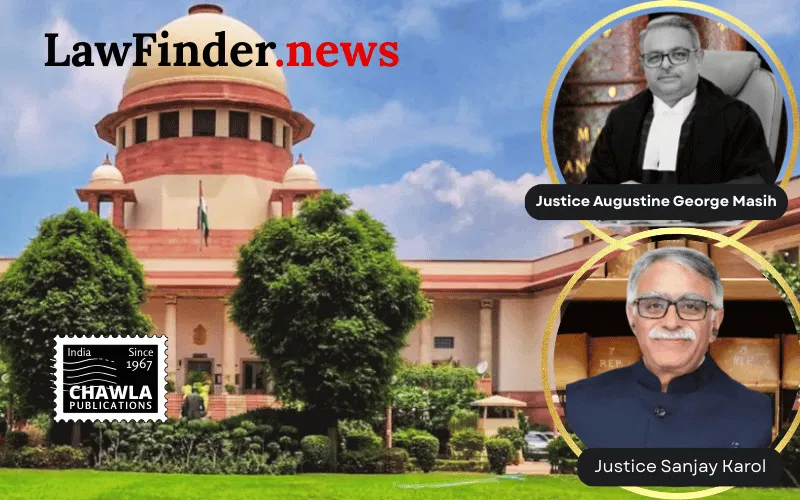
"The courts in India have repeatedly established that withholding sexual intimacy inflicts severe emotional distress and undermines the bedrock of marriage," a bench of Justices Sanjay Karol and Augustine George Masih said.
"Therefore, the conclusion of the high court is sustained. The decree of divorce as granted by allowing the appeal of the respondent-husband is upheld," it said.
It noted that as held in several judgments of the top court, denial of conjugal rights including persistent refusal of sexual intercourse without a reasonable cause constitutes mental cruelty and is a valid ground for divorce under Section 13(1)(ia) of the Hindu Marriage Act.
The bench noted that both the wife and the husband, who were married in December 2007, are doctors and are in government service in Gujarat and Rajasthan, respectively.
Exercising its powers under Article 142 of the Constitution to do complete justice, the top court said the marriage between the couple deserves to be dissolved as it was apparent that the wedlock has broken down irretrievably.
The top court delivered its judgement on June 2 on an appeal filed by the wife challenging a February last year order of the high court.
The high court had allowed the appeal filed by the husband and granted him divorce.
In its verdict, the apex court noted that the parties were living separately for over 15 years, there was no child from the wedlock and despite repeated efforts by the courts, there was no reconciliation.
The bench said marriage, in its legal and constitutional dimension, can never be reduced to a mere contractual intersection of individual rights, nor can it be viewed strictly through the narrow lens of a petition for conjugal rights.
"It is a deeply personal and social partnership built on mutual respect, shared expectations and equal responsibility. When two parties enter into matrimony, they weave a tapestry of interdependence that demands a continuous balancing of interests," it said.
The bench said conjugal rights do not exist in a vacuum and that they are the structural counterparts to conjugal duties.
"To demand the fulfilment of the former while wilfully abandoning the sanctity of the latter is to undermine the very essence of the institution," the bench said.
It said persistent withdrawal from the foundational aspects of marriage may have legal consequences while evaluating allegations of mental cruelty.
The bench said from the conduct of parties in this case, it was clear that even during the short period of cohabitation, they failed to perform their conjugal responsibilities.
"This court is conscious of the view that approach of the courts should be to preserve the sanctity of marriage and the court should be reluctant to dissolve the marriage at the mere asking of one of the parties," it said.
The bench said in this case, the parties had lived separately for far too long a period of time and there was no sanctity left in the marriage.
Although it was claimed by the wife, it said, that she had left her job in Gujarat and started living in Rajasthan, no evidence has come on record to substantiate the claim.
"Rather the evidence on record is to the contrary and it is not disputed that she still continues with her job in Gujarat. There appears to be no intention on her part to join company of the husband as actions speak more than the dry words," the bench said.
It added, "This court is also of the view that prolonged pendency of matrimonial litigation only leads to perpetuity of marriage on paper."
The bench said it was in the best interest of parties and the society if ties were severed between parties in cases where litigation was pending for a considerably long period of time.
"Prolongation of a matrimonial relationship would further lead not only to escalation of frustration in a dead relationship, which has already decayed and is decomposing day by day creating foul sociological, psychological and mental hollowness in life resulting in denial of a free and independent environment to flourish which each human strives in body and soul," it said.
The bench, while dismissing the appeal filed by the wife, dissolved the marriage between the couple.