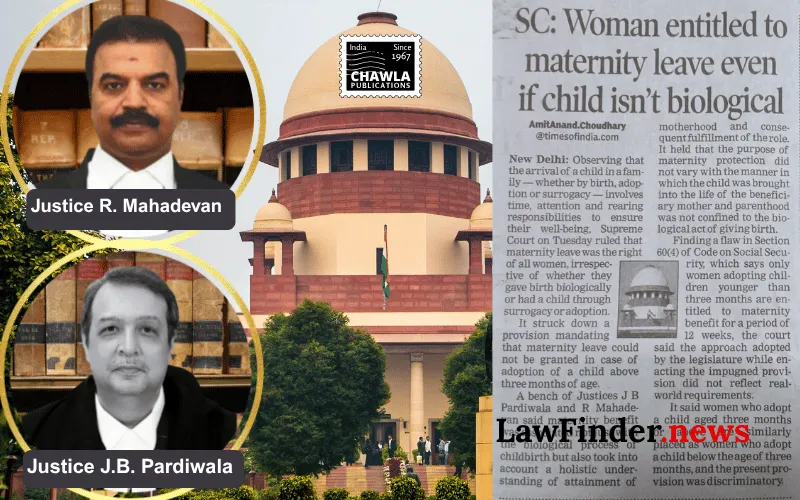
Supreme Court Declares Age Limit in Maternity Benefit for Adoptive Mothers Unconstitutional, Section 60(4) of the Code on Social Security, 2020, restricting maternity benefit to adoption of children below three months, violates Articles 14 and 21 of the Constitution; Court extends maternity benefit to all adoptive mothers regardless of child’s age
In a landmark judgment delivered on March 17, 2026, the Supreme Court of India struck down the age restriction imposed under Section 60(4) of the Code on Social Security, 2020 (previously Section 5(4) of the Maternity Benefit Act, 1961), which limited maternity benefits for adoptive mothers to those adopting children below three months of age. The Bench comprising Justices J.B. Pardiwala and R. Mahadevan held that this restriction was unconstitutional as it violated the fundamental rights enshrined under Articles 14 (Right to Equality) and 21 (Right to Life and Personal Liberty) of the Constitution of India.
The petitioner, Hamsaanandini Nanduri, an adoptive mother, challenged the provision on grounds that the arbitrary three-month age limit created unreasonable classification among adoptive mothers, depriving those adopting older children of maternity benefits, thereby undermining their reproductive autonomy and denying the best interests of the child.
Rejecting the government’s argument that the three-month limit was justified by the reduced caregiving needs of older infants and that crèche facilities could substitute maternity leave, the Court observed that the purpose of maternity benefit transcends biological childbirth and includes the holistic process of motherhood involving physical, emotional, and social dimensions. The Court emphasized that adoption is an exercise of reproductive autonomy and that the development of a mother-child bond is a gradual process, irrespective of the child's age at adoption.
The Court examined the procedural realities of adoption under the Juvenile Justice (Care and Protection of Children) Act, 2015, and the CARA Regulations, 2022, noting that the legal process to declare a child "legally free for adoption" and complete adoption formalities typically exceeds three months. Consequently, the existing restriction rendered the maternity benefit practically inaccessible for most adoptive mothers.
Further, the Court underscored the constitutional principle of equality, holding that the classification between adoptive mothers based on the child’s age lacked a rational nexus with the legislative objective and was under-inclusive, resulting in unjust discrimination. It highlighted international jurisprudence, including rulings from South Africa and the European Court of Human Rights, which have invalidated similar age-based restrictions on parental leave for adoptive parents.
Recognizing the vital role of institutional support in addressing the gendered burden of unpaid caregiving work, the Court urged the government to introduce paternity leave provisions to promote shared parenting and gender equality.
In conclusion, the Court read down Section 60(4) of the Code on Social Security, 2020, to remove the three-month age limit, thereby entitling every woman who legally adopts a child to maternity benefit for twelve weeks from the date of adoption, irrespective of the child’s age. The judgment marks a significant step in recognizing the evolving nature of motherhood and the rights of adoptive parents, reinforcing the constitutional guarantees of equality, dignity, and reproductive autonomy.
Bottom Line:
Section 60(4) of the Code on Social Security, 2020, which restricts maternity benefit for adoptive mothers to children below three months of age, is unconstitutional as it violates Articles 14 and 21 of the Constitution by creating unreasonable classification and denying adoptive mothers of older children the right to maternity benefit.
Statutory provision(s):
Code on Social Security, 2020 Section 60(4), Maternity Benefit Act, 1961 Section 5(4), Juvenile Justice (Care and Protection of Children) Act, 2015 Sections 2(9), 3, Central Civil Services (Leave) Rules Sections 43A, 43AA, International Conventions (UDHR, ICESCR, CEDAW, CRC)
This detailed Supreme Court judgment reaffirms maternity benefit as a fundamental right integral to the dignity and equality of women, regardless of biological or adoptive motherhood. It mandates legislative and administrative recognition that maternity protection must be inclusive and practically accessible, reflecting the realities of adoption and caregiving.
Hamsaanandini Nanduri v. Union of India, (SC) : Law Finder Doc id # 2867207