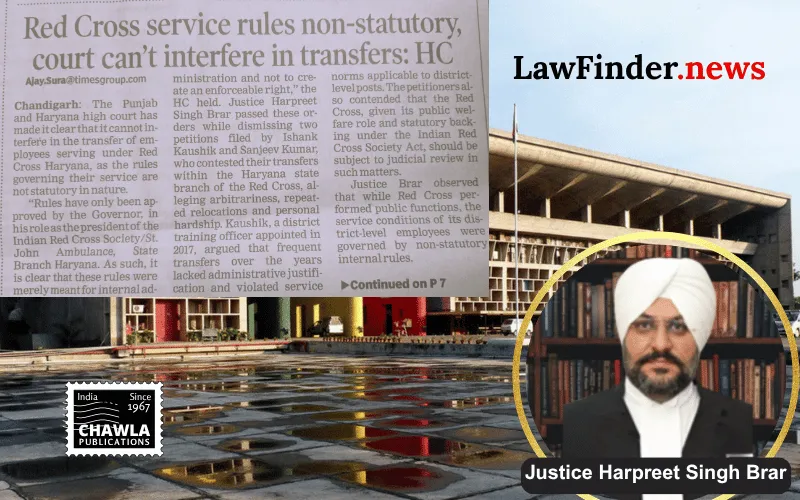
Court affirms that non-statutory service rules lack the public law element necessary for invoking Article 226 in employment matters
In a significant ruling, the Punjab and Haryana High Court dismissed petitions filed by Ishank Kaushik and others against the Indian Red Cross Society and St. John Ambulance (India), Haryana State Branch. The petitioners had challenged frequent transfer orders issued by the society, arguing that these were arbitrary and lacked administrative justification. The court, however, concluded that the service rules governing the employees of the Indian Red Cross Society were non-statutory in nature and thus did not possess the public law element required to invoke writ jurisdiction under Article 226 of the Constitution of India.
The judgment, delivered by Justice Harpreet Singh Brar, emphasized that writ jurisdiction is applicable only when service conditions are governed by statutory rules. The court noted that while the Indian Red Cross Society performs public welfare functions, the specific service rules in question were merely for internal management and lacked statutory backing. Consequently, the petitioners could not seek relief through the High Court's writ jurisdiction for what was essentially a private employment dispute.
The court's decision referenced several Supreme Court precedents, reinforcing the principle that private contractual disputes without a public law element are not amenable to judicial review under Article 226. The judgment clarified that frequent transfers, unless proven to be mala fide or in violation of statutory provisions, are considered a normal incident of service.
The court advised the petitioners to explore alternate legal remedies outside the writ jurisdiction, thereby dismissing both the petitions while allowing the petitioners the liberty to pursue other legal avenues. This ruling underscores the limitations of writ jurisdiction in employment matters involving non-statutory rules and reinforces the distinction between public and private law elements in service disputes.
Bottom Line:
Service disputes concerning non-statutory rules governing employees of a private society lack the public law element necessary to invoke writ jurisdiction under Article 226 of the Constitution.
Statutory provision(s):
Constitution of India, Article 226