Court Sets Aside Time-Barred Notices and Non-Speaking Tribunal Orders, Upholding Textile Committee's Initial Stand
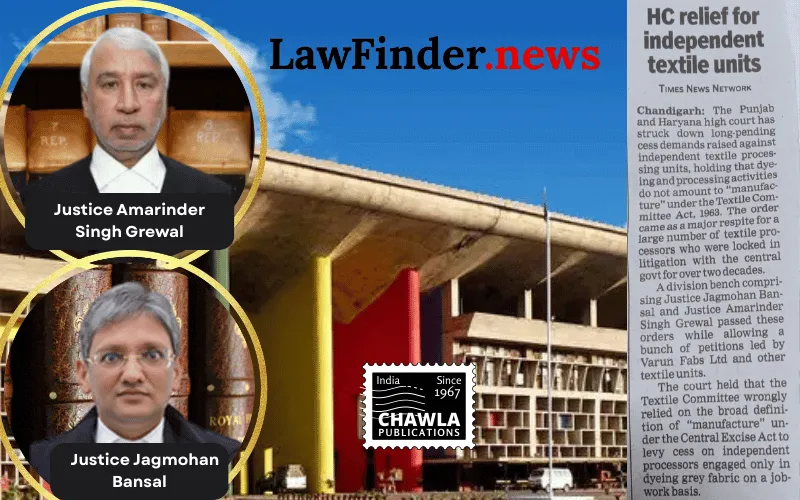
In a significant ruling, the Punjab and Haryana High Court has quashed the levy of cess on independent processing units involved in dyeing and processing of grey fabric, as these entities are not considered manufacturers of textiles under the Textile Committee Act, 1963. The division bench, comprising Justices Jagmohan Bansal and Amarinder Singh Grewal, delivered the verdict on December 24, 2025, in the case of M/s Varun Fabs Ltd. v. Union of India and others.
The court held that the definition of 'manufacture' under the Central Excise Act cannot be borrowed for the purpose of levying cess under the Textile Committee Act. The cess, originally intended to be collected at the stage of yarn manufacturing, was deemed sufficient, thus excluding independent processors from this financial obligation. The court underscored that the notices issued for the period between 1995-1998 in the year 2000 were beyond the one-year limitation period prescribed under Rule 10 of the Textile Committee (Cess) Rules, 1975, thereby rendering them time-barred.
The case originated from three demand notices served to M/s Varun Fabs Ltd. on March 6, 2000, demanding cess for the fiscal years 1995-96, 1996-97, and 1997-98. The petitioner, represented by Senior Advocate Mr. Puneet Jindal, contended that the company engaged only in fabric processing, not manufacturing, thus falling outside the ambit of Section 5A of the 1963 Act.
The High Court also criticized the Appellate Tribunal's handling of the appeals, setting aside its non-speaking and mechanical orders, which dismissed the appeals without adequately considering the factual and legal issues involved. The court emphasized the fundamental principle that statutory definitions from one Act, especially taxing statutes, cannot be arbitrarily applied to another unless explicitly provided.
The Textile Committee itself, in past resolutions and communications, had recognized the impracticality and inapplicability of imposing cess on independent processing units. The Committee's 84th meeting and subsequent government actions, including a 2007 notification exempting such units from cess and the eventual repeal of the Act in 2016, supported the court's decision.
This judgment reinforces the legal principle against retroactive taxation and underscores the necessity for clear legislative intent and consistency in tax laws. It offers a significant relief to numerous independent textile processors across India, securing their operations from retrospective and arbitrary financial liabilities.
Bottom Line:
Textile Committee Act, 1963 - Levy of cess on independent processing units - Held, cess should not be levied on independent processing units as they are not manufacturers of textiles - Notices issued beyond the limitation period of one year prescribed under Rule 10 of the Textile Committee (Cess) Rules, 1975 are barred by limitation.
Statutory provision(s): Textile Committee Act, 1963, Section 5A; Textile Committee (Cess) Rules, 1975, Rule 10
M/s Varun Fabs Ltd. v. Union of India, (Punjab And Haryana)(DB) : Law Finder Doc Id # 2828140