Court mandates pay parity for PUNBUS drivers and conductors with regular counterparts in Punjab Roadways, emphasizing constitutional rights.
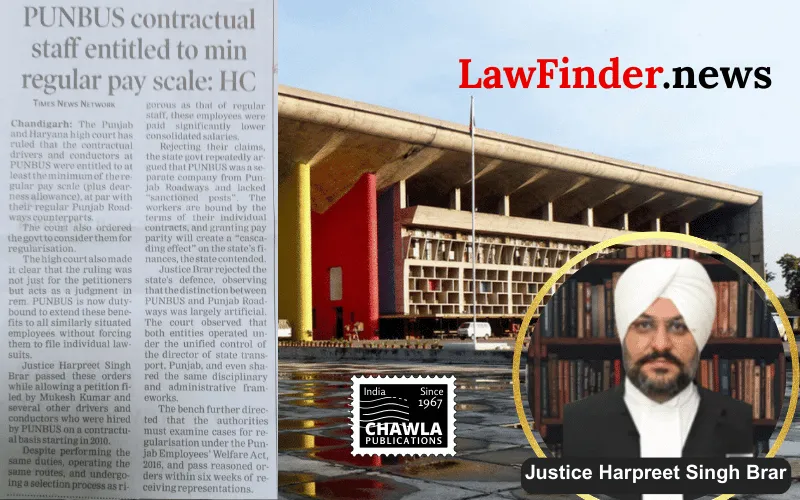
The Punjab and Haryana High Court has delivered a landmark judgment in the case of Mukesh Kumar v. State of Punjab, reinforcing the constitutional principle of 'equal pay for equal work' for contractual employees. Presided over by Justice Harpreet Singh Brar, the court ruled that drivers and conductors engaged on a contractual basis with the Punjab State Bus Stand Management Company Limited (PUNBUS) are entitled to pay parity with their regular counterparts in Punjab Roadways.
The petitioners, employed by PUNBUS since 2010 and transitioned to contract basis in 2015, argued that despite performing identical duties as regular employees, they were remunerated significantly less. The court found that the nature of duties, responsibilities, and qualifications of the petitioners were indistinguishable from those of their regular counterparts, thereby warranting the application of the principle of 'equal pay for equal work' as enshrined in Articles 14, 16, and 39(d) of the Constitution of India.
Justice Brar noted the unified administrative control between PUNBUS and Punjab Roadways, undermining the argument of separate management structures. The judgment highlighted that the petitioners' engagement on non-sanctioned posts does not preclude them from claiming pay parity, citing the Supreme Court's ruling in Dhirendra Chamoli v. State of Uttar Pradesh.
Furthermore, the court addressed the prolonged contractual engagement of the petitioners, deeming it exploitative. It directed the respondents to consider their regularization under The Punjab Ad hoc, Contractual, Daily Wage, Temporary, Work Charged and Outsourced Employees' Welfare Act, 2016, which remains in effect.
The judgment is intended as a judgment in rem, extending benefits to all similarly situated employees without necessitating individual litigation, thus reinforcing the principle of equality and preventing discrimination against contractual employees.
Bottom Line:
Principle of 'equal pay for equal work' applies to contractual employees engaged for identical duties as regular employees, emphasizing constitutional protections under Articles 14, 16, and 39(d).
Statutory provision(s): Articles 14, 16, 21, 39(d) of the Constitution of India; Article 226 of the Constitution; Punjab Ad hoc, Contractual, Daily Wage, Temporary, Work Charged and Outsourced Employees' Welfare Act, 2016.
Mukesh Kumar v. State of Punjab, (Punjab And Haryana) : Law Finder Doc id # 2864239