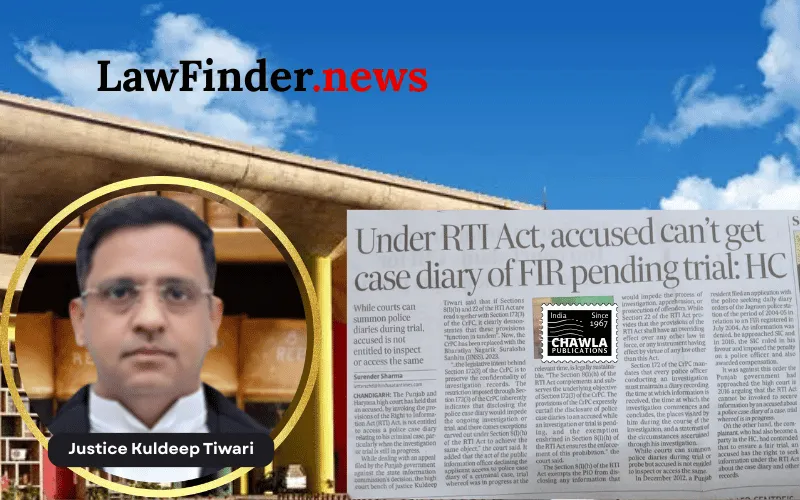
Court rules accused cannot access police diaries during ongoing trials; overturns penalties and compensation imposed by State Information Commission.
In a significant ruling, the Punjab and Haryana High Court has affirmed the principle of confidentiality in criminal investigations, holding that accused individuals are not entitled to access police case diaries or 'zimni' entries related to their own criminal cases under the Right to Information (RTI) Act while investigations or trials are ongoing. This decision came in response to writ petitions challenging the orders of the State Information Commission, which had imposed penalties and awarded compensation under the RTI Act.
The High Court, presided over by Justice Kuldeep Tiwari, heard two writ petitions filed by the State of Punjab and others against the orders dated February 8, 2016, of the State Information Commission. These orders had penalized the petitioners and awarded compensation to the respondent, who sought access to specific police records under the RTI Act.
The court emphasized that the provisions of Section 8(1)(h) of the RTI Act and Section 172(3) of the Criminal Procedure Code (Cr.P.C.) work in tandem to maintain the confidentiality of police case diaries during active investigations and trials. Justice Tiwari noted that allowing access to these records could impede ongoing investigations and compromise the safety of informants and witnesses.
Citing relevant precedents, the court reiterated that the RTI Act’s exemptions, particularly Section 8(1)(h), serve the purpose of preserving the integrity of criminal investigations as intended by Section 172(3) of the Cr.P.C. The court also underscored that the legislative intent was to prevent prejudice and ensure a fair trial by restricting access to sensitive information.
The court further clarified that penalties under Section 20 of the RTI Act are personal and cannot be imposed on individuals not designated as Public Information Officers. In this case, the penalty imposed on the Senior Superintendent of Police, who was not the designated officer, was found to be erroneous. Additionally, the compensation awarded was set aside due to the lack of evidence of actual loss suffered by the RTI applicant.
This ruling reinforces the delicate balance between transparency and the need to protect the confidentiality of ongoing criminal proceedings, underscoring the judiciary's role in safeguarding both public interest and individual rights within the framework of the law.
Bottom Line:
An accused cannot access police case diaries or 'zimni' entries related to their own criminal case under the RTI Act while the investigation or trial is still in progress. Section 172(3) of Cr.P.C. and Section 8(1)(h) of the RTI Act restrict such disclosures to maintain confidentiality and ensure fair trial.
Statutory provision(s): Section 8(1)(h) of the RTI Act, Section 19(8)(b) of the RTI Act, Section 20 of the RTI Act, Section 172(3) of the Cr.P.C.
State of Punjab v. State Information Commission, (Punjab And Haryana) : Law Finder Doc id # 2864853