Court Prioritizes National Security and Public Order Over Individual Rights in Landmark Decision
In a significant judgment delivered on March 27, 2026, the Punjab and Haryana High Court dismissed the petition filed by Amritpal Singh, a sitting Member of Parliament from the Khadoor Sahib Constituency, Amritsar, seeking temporary release from preventive detention to attend the ongoing Parliamentary session. The court ruled that individual rights, including liberty and freedom of speech, must be subordinate to the overarching concerns of public order, state security, and national interests.
The petitioner, Amritpal Singh, who has been under preventive detention since April 2025, argued that his temporary release was necessary to address urgent issues affecting his constituents in Parliament, such as the aftermath of devastating floods and the rise in drug abuse in Punjab. He also cited the constitutional mandate under Article 101, which could lead to his parliamentary seat being declared vacant due to prolonged absence.
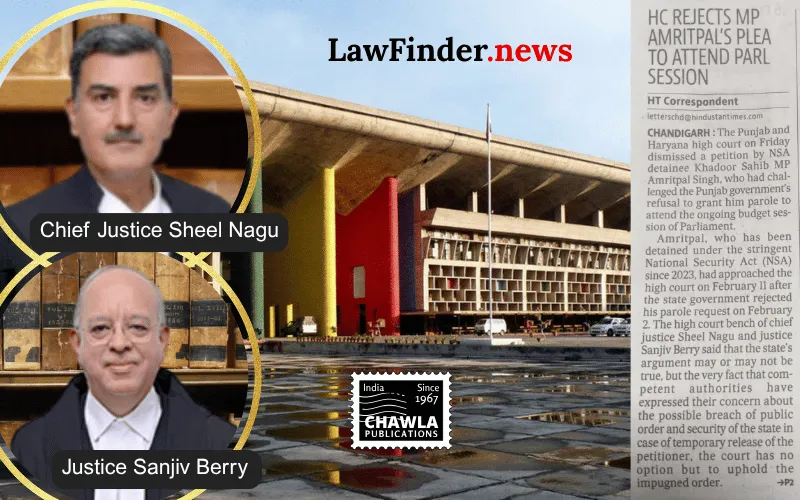
However, the court, led by Chief Justice Sheel Nagu and Justice Sanjiv Berry, emphasized that the National Security Act, 1980, allows for preventive detention when public order and state security are at stake. The judgment underscored that there are no special privileges for detained Members of Parliament over ordinary citizens, affirming the principle that national interests take precedence over personal interests.
The government's decision to deny Singh's temporary release was supported by reports from the District Magistrate and Senior Superintendent of Police, Amritsar, indicating a threat to public order and state security should he be released. The court noted that while the petitioner could seek exemption from parliamentary proceedings, such a request does not override the concerns of public order and security.
The judgment referenced several landmark cases, including A.K. Roy v. Union of India and Rekha v. State of Tamil Nadu, reinforcing the notion that preventive detention is a legitimate tool for maintaining public order and security when ordinary criminal laws are insufficient.
In its decision, the court asserted the subjective satisfaction of the competent authorities regarding the threat perception and upheld the non-speaking order dated February 2, 2026, rejecting Singh's plea for temporary release. The court's ruling is a reaffirmation of the legal framework governing preventive detention, highlighting the balance between individual rights and national security.
Bottom Line:
Preventive detention - Temporary release of preventively detained Member of Parliament to attend Parliamentary session - Denied on grounds of security and public order concerns - Held, individual rights, including liberty and speech, are subservient to the larger concept of public order, security of the state, and national interests.
Statutory provision(s): National Security Act, 1980 Section 15, Constitution of India, 1950 Articles 21, 22, 105, 101
Amritpal Singh v. Union of India, (Punjab And Haryana)(DB) : Law Finder Doc id # 2873489