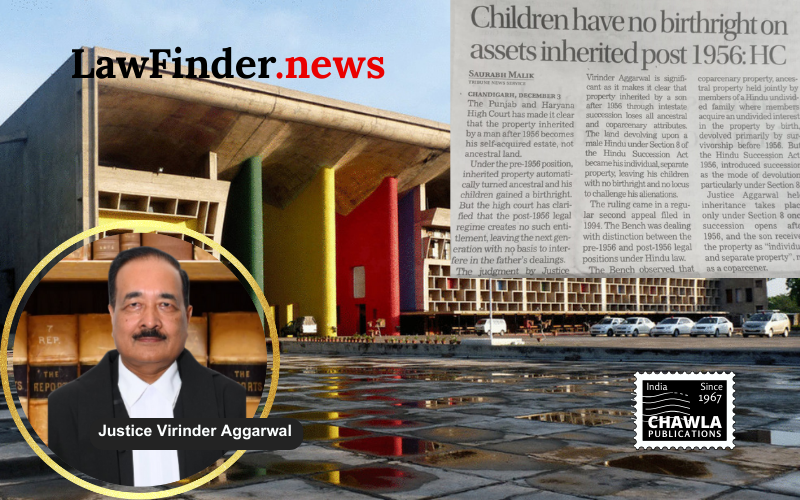
Sons Lack Birthright in Property Inherited by Father Post-1956, Rules Court
In a significant ruling, the Punjab and Haryana High Court, presided over by Justice Virinder Aggarwal, has upheld the decision of the Additional District Judge, Ludhiana, regarding the status of property inherited under the Hindu Succession Act, 1956. The court ruled that property inherited by a son under Section 8 of the Act loses its ancestral character and becomes the self-acquired property of the heir, thereby negating any birthright claims by his sons.
The case, titled "Amarjit Singh v. Rattan Singh," involved a dispute over the ancestral nature of agricultural land in Ludhiana. The plaintiffs, Amarjit Singh and others, contended that the land, originally owned by their grandfather Chanan Singh, should be considered coparcenary property, allowing them rights to challenge alienations made by their father, Rattan Singh.
The trial court had partially sided with the plaintiffs, voiding two out of three sale deeds made by Rattan Singh. However, the appellate court reversed this decision, leading to the present appeal. The High Court reaffirmed the appellate court's judgment, emphasizing that under Section 8 of the Hindu Succession Act, property devolves as self-acquired and not ancestral, particularly when female Class I heirs are present at the time of the original owner's death.
The court's ruling was anchored in the distinction between pre-1956 and post-1956 Hindu law. Prior to the Act, coparcenary property devolved by survivorship. Post-1956, however, the Act mandates succession, transforming inherited property into self-acquired assets. The court noted that Chanan Singh's death occurred post-1956, thus invoking the proviso to Section 6 and Section 8, resulting in the property becoming Rattan Singh's separate property.
This decision aligns with previous Supreme Court judgments, including "Commissioner of Wealth Tax v. Chander Sen" and "Yudhishter v. Ashok Kumar," which clarify that property inherited under Section 8 does not retain its ancestral character.
The High Court also distinguished this case from precedents like "Arshnoor Singh v. Harpal Kaur" and clarified that the 2020 judgment in "Vineeta Sharma v. Rakesh Sharma," which addresses coparcenary rights post-2005 amendments, does not apply retroactively to properties devolved under Section 8 before the amendment.
In conclusion, the court dismissed the appeal, affirming that the property in question is self-acquired in Rattan Singh's hands, and his sons have no legal standing to contest its alienation. This ruling reinforces the legal framework distinguishing between ancestral and self-acquired property under the Hindu Succession Act, 1956, providing clarity on inheritance rights in similar contexts.
Bottom Line:
Property inherited under Section 8 of the Hindu Succession Act, 1956, loses its ancestral/coparcenary character and becomes the self-acquired property of the heir. Sons cannot claim birthright or coparcenary interest in such property.
Statutory provision(s): Hindu Succession Act, 1956 Sections 6 and 8
Amarjit Singh v. Rattan Singh, (Punjab And Haryana) : Law Finder Doc Id # 2817469