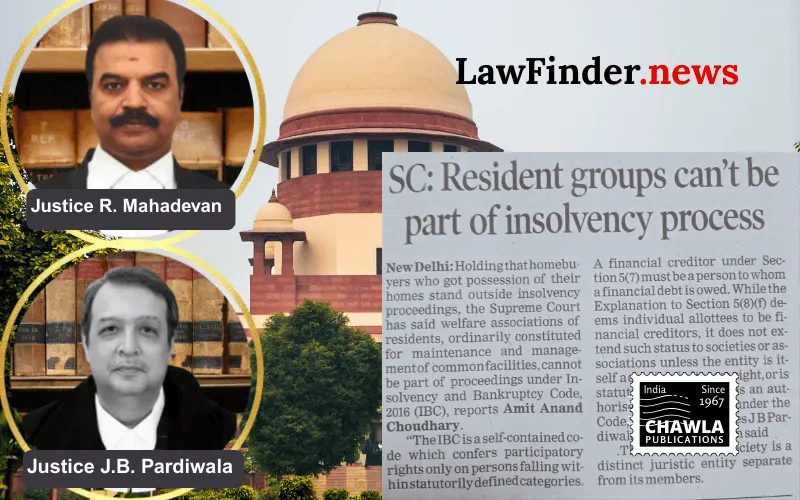
Supreme Court Upholds NCLAT Decision to Admit Takshashila Heights into CIRP; Society's Intervention Rejected In a landmark judgment, the Supreme Court of India reaffirms the mandatory admission of corporate debtors into insolvency proceedings upon establishing debt and default, while rejecting a society's bid to intervene.
In a significant decision, the Supreme Court of India has upheld the National Company Law Appellate Tribunal's (NCLAT) order to initiate the Corporate Insolvency Resolution Process (CIRP) against Takshashila Heights India Private Limited, a real estate developer. The judgment, delivered by a bench comprising Justices J.B. Pardiwala and R. Mahadevan, emphasized the mandatory nature of admitting a corporate debtor into CIRP once financial debt and default are established, underscoring that discretionary considerations are not applicable at the admission stage under Section 7 of the Insolvency and Bankruptcy Code, 2016 (IBC).
The appeal by Takshashila Heights, which contended that the CIRP was invoked as a recovery mechanism rather than for insolvency resolution, was dismissed. The Supreme Court reiterated that the existence of financial debt and occurrence of default are the sole criteria for admission under Section 7, and considerations like project viability or homebuyer interests are irrelevant at this juncture. The Court also clarified that the much-cited Vidarbha Industries case is a narrow exception and does not alter the mandatory admission principle.
Additionally, the Court dismissed an intervention application by Elegna Co-operative Housing and Commercial Society Ltd., which sought to represent homebuyers. The society argued that its members' interests were directly affected by the CIRP. However, the Court held that societies or associations of homebuyers do not possess locus standi to intervene in Section 7 proceedings unless they are financial creditors in their own right or are statutorily recognized representatives.
The judgment reaffirmed the framework of the IBC, which does not extend participatory rights to unrelated third parties at the admission stage. The Court emphasized that the rights of homebuyers are adequately protected through representation in the Committee of Creditors and other statutory mechanisms, aligning with precedents that prioritize the resolution and revival of corporate debtors over mere recovery.
In response to concerns about the misuse of CIRP for recovery purposes, the Court reiterated that the IBC is not a tool for coercion or recovery but aims at the revival of corporate debtors. The judgment also highlighted that the pendency of recovery proceedings under other statutes does not preclude the initiation of insolvency proceedings under the IBC.
The Supreme Court's decision has reaffirmed the structured insolvency process under the IBC, ensuring that genuine financial distress is addressed through timely resolution, while also safeguarding the interests of homebuyers within the statutory framework.
Bottom Line:
Corporate Insolvency Resolution Process (CIRP) - Admission of a Corporate Debtor into CIRP is mandatory once financial debt and default are established, and discretionary considerations do not apply at the admission stage. Societies or associations of homebuyers lack locus standi to intervene in proceedings under Section 7 of the Insolvency and Bankruptcy Code, 2016, unless they are financial creditors in their own right or are statutorily recognized representatives.
Statutory provision(s): Insolvency and Bankruptcy Code, 2016 - Section 7, Rule 11 of NCLAT Rules, 2016, Regulation 4E of IBBI (Insolvency Resolution Process for Corporate Persons) Regulations, 2016, Real Estate (Regulation and Development) Act, 2016 (RERA), SARFAESI Act, 2002.