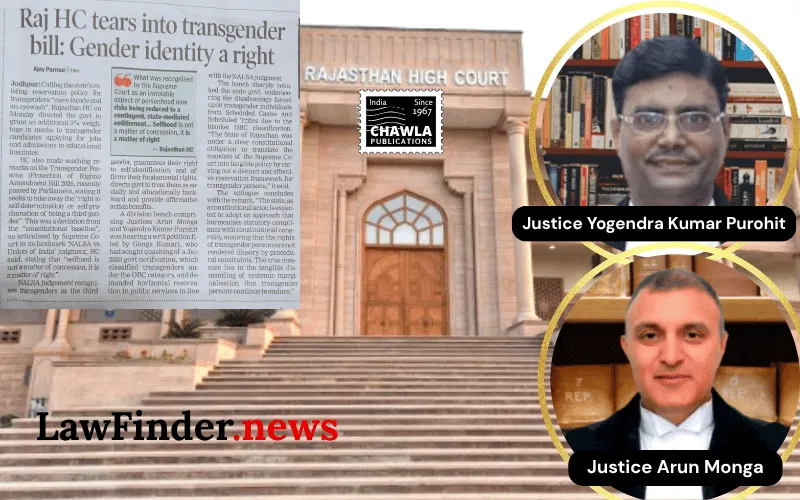
Court Criticizes State's Current Notification and Recommends Immediate Measures for Transgender Inclusion
In a landmark decision, the Rajasthan High Court has directed the state government to establish a committee to address the systemic marginalization faced by transgender individuals, criticizing the current notification for failing to provide meaningful reservations. The court emphasized the need for a comprehensive policy framework to ensure substantive equality for transgender persons in public employment and education.
The case, brought forth by petitioner Ganga Kumari, challenged a state notification that included transgender persons in the Other Backward Classes (OBC) category without granting them specific horizontal reservations. The court found the notification to be a mere formality, failing to meet the mandates established by the Supreme Court in the NALSA judgment and the Transgender Persons (Protection of Rights) Act, 2019.
The bench, comprising Justices Arun Monga and Yogendra Kumar Purohit, highlighted the acute marginalization and vulnerability faced by transgender individuals, particularly those born into SC/ST/SEBC families. The court criticized the notification for creating administrative confusion and not providing any real benefits to the transgender community. It urged the state to undertake a detailed study to recommend actionable measures for addressing compounded marginalization.
In its interim relief, the court ordered the state to grant a 3% additional weightage in selection and appointment processes to transgender persons. The court also pointed to positive steps taken by states like Karnataka and Tamil Nadu in granting horizontal reservations to transgenders, suggesting Rajasthan consider similar legislative action.
Justice Monga, in his order, emphasized the court's role in ensuring that constitutional rights are not just lofty pronouncements but translated into lived realities. He urged the legislative and executive branches to frame policies in alignment with constitutional principles and the NALSA judgment, recognizing transgender persons as a distinct gender with specific rights and entitlements.
The court's decision marks a significant step toward ensuring the rights of transgender individuals are upheld in Rajasthan, setting a precedent for other states to follow.
Bottom Line:
Transgender rights - Recognition of transgender persons as a distinct gender and the grant of horizontal reservation - State's obligation to translate the Supreme Court's mandate into tangible policies to address systemic marginalization of transgender individuals.
Statutory provision(s): Articles 14, 15, 16, and 21 of the Constitution of India, Article 226 of the Constitution of India, Transgender Persons (Protection of Rights) Act, 2019, National Legal Services Authority v. Union of India (2014).
Ganga Kumari v. State of Rajasthan, (Rajasthan)(DB) : Law Finder Doc id # 2874635