Court rules that employment disputes with private institutions not maintainable under writ jurisdiction in absence of public law element.
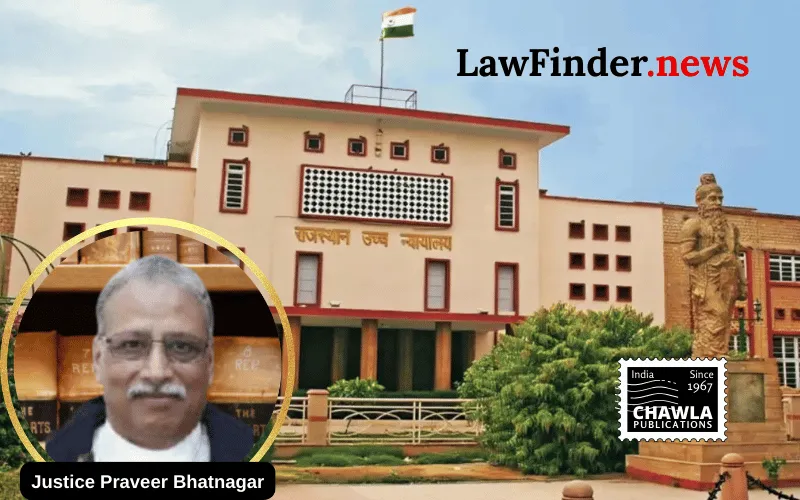
In a significant ruling, the Rajasthan High Court's Jaipur Bench has dismissed a writ petition filed by Atal Khandelwal against the Institute of Health Management Research concerning the termination of his employment. The court, presided over by Justice Praveer Bhatnagar, held that the writ petition was not maintainable as the dispute was purely contractual and lacked any public law element.
The petitioner, Atal Khandelwal, had challenged his termination from the Institute of Health Management Research, arguing that the institution performs public functions, thereby qualifying as "other authority" under Article 12 of the Constitution of India. This, he contended, would make it amenable to writ jurisdiction under Article 226.
However, the court noted that the respondent institution, being registered under the Societies Registration Act, is not a statutory body and does not qualify as "State" under Article 12. The court further observed that mere discharge of public functions does not render an institution a "State" unless it is created by a statute or is under significant governmental control.
Justice Bhatnagar referenced several Supreme Court judgments, including the Army Welfare Education Society v. Sunil Kumar Sharma and St. Mary's Education Society v. Rajendra Prasad Bhargava, to emphasize that writ jurisdiction under Article 226 is not applicable to private contractual disputes unless a public law element is involved. The court highlighted that the relationship between the petitioner and the respondent was purely contractual and private, with no statutory backing, thus falling outside the purview of writ jurisdiction.
The court's decision underscores the distinction between public duties and private employment contracts, reaffirming that private disputes without statutory elements are not subject to judicial review under Article 226. The dismissal of the petition reflects the judiciary's stance on maintaining the boundaries of writ jurisdiction concerning private employment matters.
The court concluded by dismissing the writ petition in limine due to lack of maintainability, with all pending applications also disposed of and no order as to costs.
Bottom Line:
Writ petition against a private institution for termination of employment not maintainable if the dispute is purely contractual and lacks a public law element.
Statutory provision(s): Article 226, Article 12, Constitution of India, Societies Registration Act