Court Criticizes Family Court's Decision, Highlights Cruelty and Forced Marital Practices
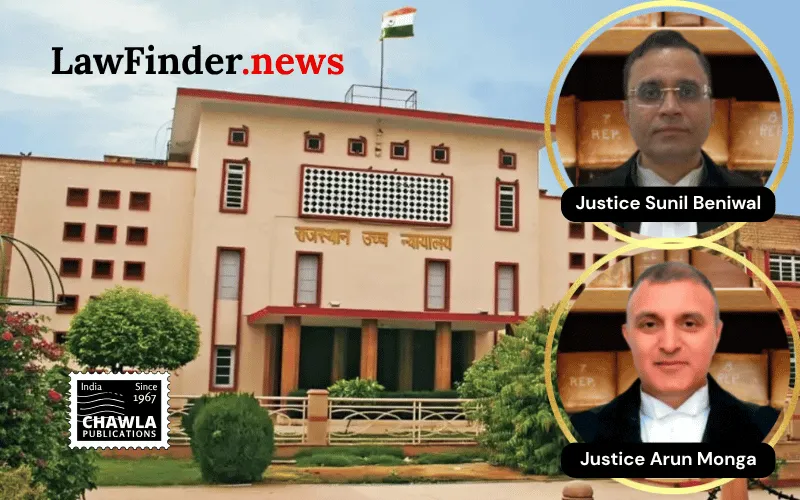
In a significant ruling, the Rajasthan High Court has overturned a Family Court decision, dissolving the marriage between Kiran Bishnoi and Sunil Kumar. The appeal, heard by a division bench comprising Justices Arun Monga and Sunil Beniwal, centered around allegations of cruelty and the controversial practice of 'atta-satta,' a customary exchange marriage.
Kiran Bishnoi had initially filed for divorce citing cruelty by her husband and his family, including harassment for dowry and physical abuse. The Family Court in Bikaner had previously dismissed her petition, attributing the marital discord primarily to disputes arising from the 'atta-satta' custom, which involves the reciprocal marriage of siblings between two families. In this case, it was linked to the refusal of Sunil Kumar's sister to continue her marriage with Kiran's brother, which the Family Court saw as the root cause of the marital issues.
However, the High Court found that the Family Court had erred by conflating the 'atta-satta' dispute with the issue of matrimonial cruelty. The judges highlighted that cruelty in marriage must be assessed independently and is not limited to physical acts but includes sustained emotional and psychological abuse. They pointed out that the Family Court failed to recognize the standard of proof in matrimonial cruelty cases, which is based on the preponderance of probabilities rather than proof beyond a reasonable doubt.
The High Court criticized the Family Court for not adequately considering the evidence of sustained emotional stress and harassment faced by Kiran. It emphasized that mere co-residence under duress cannot be equated with voluntary cohabitation, and that Kiran's legal actions were necessary defensive measures rather than malicious attempts to exert undue pressure.
Moreover, the judgment took a strong stance against the 'atta-satta' practice, especially when involving minors, stating that it commodifies children and suppresses individual consent, violating constitutional principles. The court underscored the need for unequivocal repudiation of such customs, which are incompatible with the rule of law and modern societal values.
The High Court concluded that the long separation and lack of genuine effort at reconciliation by the respondent further reinforced the inference of cruelty, thus warranting the dissolution of the marriage under Section 13 of the Hindu Marriage Act, 1955.
This judgment not only grants Kiran Bishnoi her sought-after matrimonial relief but also sets a precedent against the perpetuation of coercive customs like 'atta-satta,' calling for societal and legal reforms to protect individual rights and uphold the dignity of women and children.
Bottom line:-
Hindu Marriage Act, 1955 - Cruelty as a ground for divorce must be assessed independently of collateral family disputes, such as those arising from the customary practice of 'atta-satta.' Family Court erred in conflating matrimonial cruelty with external family disagreements, thereby misapplying the standard of proof.
Statutory provision(s): Hindu Marriage Act, 1955 - Section 13, Indian Penal Code - Sections 498A, 406, 323, 34, Code of Criminal Procedure - Sections 107, 116(3), 125
Kiran Bishnoi v. Sunil Kumar, (Rajasthan)(DB) : Law Finder Doc id # 2887964