Court rules in favor of Satu Lal, mandates regularization and service benefits for continuous employment since 1984.
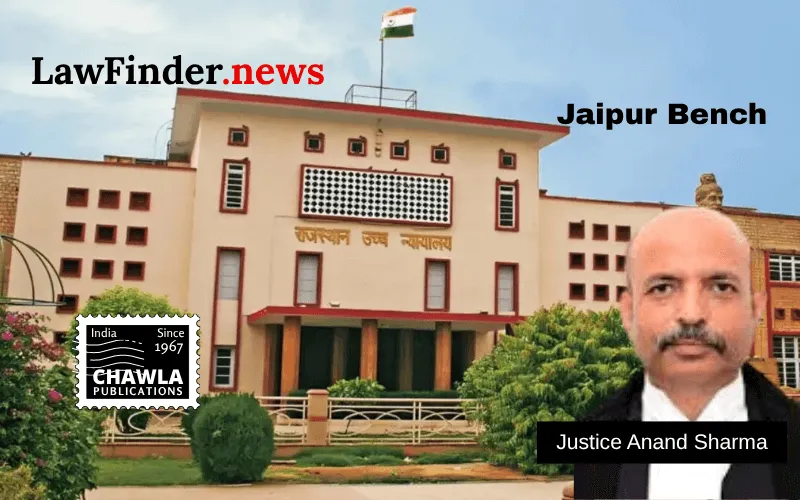
In a significant judgment, the Rajasthan High Court, Jaipur Bench, presided by Justice Anand Sharma, has ruled in favor of Satu Lal, a long-serving Class IV employee, mandating his regularization in service. The judgment, delivered on January 6, 2026, emphasizes the constitutional principles of fairness, equality, and dignity of labor, stating that employees engaged in essential duties for an extended period cannot be denied regularization on hyper-technical grounds.
Satu Lal, who was initially engaged as a Ward Boy at the Government Ayurvedic Hospital, Dholpur, in 1984, faced termination of his services but was reinstated in 1996 following an industrial dispute resolution. Despite his continuous service, his request for regularization was repeatedly denied, leading to the filing of a writ petition seeking intervention from the High Court.
The Court highlighted that the State, as a model employer, cannot exploit labor under temporary arrangements while extracting continuous and regular work from employees. It referenced the landmark Supreme Court decision in Secretary, State of Karnataka v. Uma Devi, which carved out an exception for regularization of employees with over ten years of continuous service.
Justice Sharma noted that the petitioner had fulfilled the required conditions for regularization as per the government notification dated July 8, 2009, and that the refusal to regularize his services was arbitrary and violative of Articles 14, 16, and 21 of the Constitution.
The judgment directs the State to regularize Satu Lal’s services against a sanctioned post within three months, ensuring continuity of service and granting consequential benefits such as pay fixation, seniority, and pensionary benefits. Arrears of salary are to be restricted to the three years preceding the filing of the writ petition.
The High Court's decision is seen as a reinforcement of employees' rights and a directive against prolonged ad-hoc employment practices, urging the State to adhere to its constitutional obligations as an employer.
Bottom Line:
Regularization of services - Employees engaged in perennial and essential duties for a considerable period, despite being labeled as "part-time" or "temporary," cannot be denied regularization on hyper-technical grounds. The State, as a model employer, must act in accordance with constitutional principles of fairness, equality, and dignity of labour.
Statutory provision(s): Articles 14, 16, and 21 of the Constitution of India; Secretary, State of Karnataka v. Uma Devi, (2006) 4 SCC 1; State of Karnataka v. M.L. Kesari, (2010) 9 SCC 247; State of Punjab v. Jagjit Singh, (2017) 1 SCC 148.
Satu Lal v. State of Rajasthan, (Rajasthan)(Jaipur Bench) : Law Finder Doc Id # 2837946