Court Finds No Employer-Employee Relationship in Case Involving United India Insurance Co. Ltd. and Shanti Devi
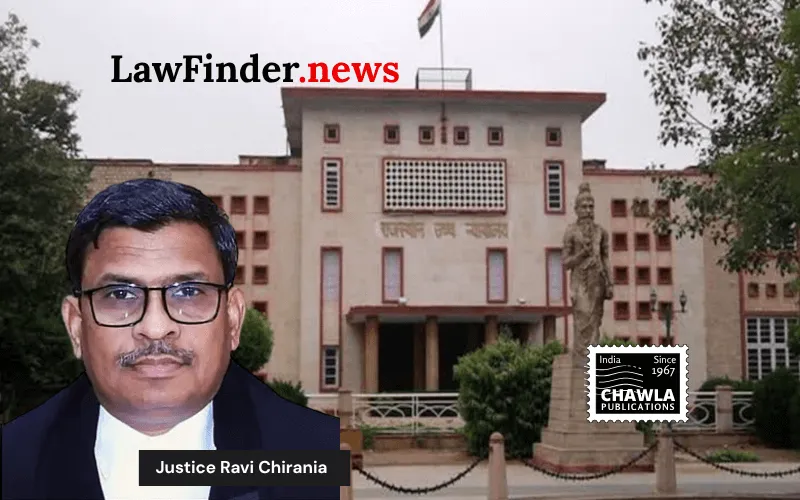
In a significant ruling, the Rajasthan High Court, Jaipur Bench, under the judgment delivered by Justice Ravi Chirania, has overturned an order by the Commissioner of Workmen's Compensation, Sikar. The judgment, dated June 1, 2026, pertains to two civil miscellaneous appeals concerning a compensation claim filed by Shanti Devi, following the death of her son, Rakesh, alleged to have been employed as a helper (Khalasi) with Jain-Travels.
The case revolved around a claim filed under the Workmen's Compensation Act, 1923, where Shanti Devi sought compensation after her son suffered fatal injuries while supposedly on duty. The Commissioner had initially ordered United India Insurance Co. Ltd., along with the bus owner Padam Chand Jain and the operator of Jain-Travels, to pay compensation of Rs. 3,70,632/- with interest from the date of the accident.
However, United India Insurance Co. Ltd. contested the decision, arguing that there was no evidence of an employer-employee relationship, which is a prerequisite for compensation under the Act of 1923. The insurance company further contended that the interest on compensation should not be awarded from the date of the accident, given the denial of liability by the employer.
Justice Chirania, upon reviewing the evidence, found that the claimant failed to provide any cogent evidence establishing the employment of the deceased with the respondents. The Court noted that humanitarian acts, such as providing medical assistance, cannot be construed as proof of employment. Moreover, the testimonies presented lacked documentary support, and no co-workers came forward to validate the employment claim.
The judgment emphasized that the Workmen's Compensation Act mandates proof of an employer-employee relationship for compensation claims to be maintainable. The Court held that the Commissioner had erred in law by assuming such a relationship without substantive evidence.
Consequently, the appeal by United India Insurance Co. Ltd. was allowed, and the compensation order was quashed. The Court directed that the compensation amount deposited by the insurance company be refunded, with specific instructions for partial restitution by the claimant, Shanti Devi.
This ruling underscores the necessity of concrete evidence in workmen's compensation claims and clarifies the legal stance on interest payment in cases of disputed liability.
Bottom line:-
Workmen's Compensation Act, 1923 - Proof of employer-employee relationship is essential for claiming compensation under the Act - Humanitarian acts such as providing medical assistance cannot be construed as proof of employment.
Statutory provision(s): Workmen's Compensation Act, 1923 Sections 30, 4A(3)