Court Criticizes Bank's Narrow Interpretation of "Indigence" and Emphasizes Holistic Assessment of Financial Hardship
In a significant judgment, the Rajasthan High Court has quashed the rejection of a compassionate appointment request by Harjeet Singh, whose father, a former Assistant Manager at Oriental Bank of Commerce, passed away due to illness. The court found that the bank's decision to deny the appointment on the grounds that the family was "not indigent or penurious" was based on an erroneous interpretation of the compassionate appointment scheme's criteria.
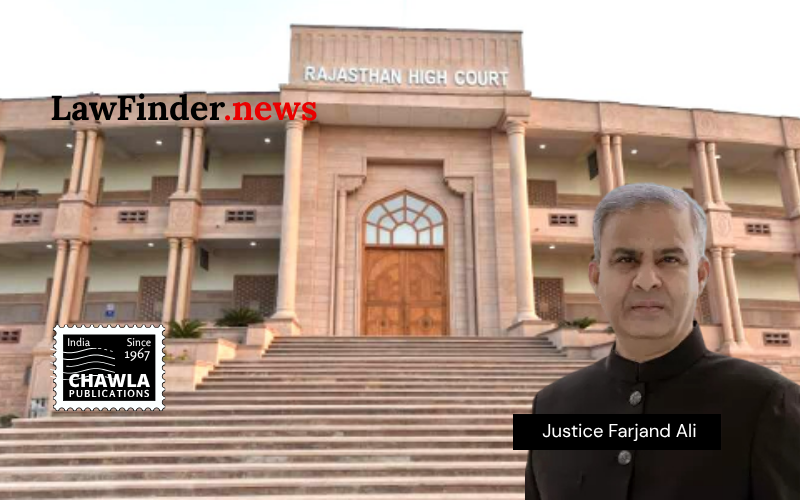
The court, presided by Justice Farjand Ali, emphasized that the term "indigent" should not be interpreted in a hyper-technical manner. It noted that the purpose of compassionate appointments is to provide immediate relief from financial distress following the untimely death of a sole breadwinner, rather than waiting for a family to descend into absolute poverty.
The case arose after Harjeet Singh's application for compassionate appointment was rejected by the bank's competent authority, citing that the family did not qualify as indigent, despite being burdened with loans and residing in rented accommodation without any source of income following the death of Singh's father. The court scrutinized the bank's reliance on terminal benefits received by the family as a basis for rejection and pointed out that these benefits were largely consumed by debts and medical expenses.
The judgment underscores that compassionate appointment schemes are designed to alleviate immediate financial distress, not to enforce a standard of indigence akin to pauperism. Justice Ali highlighted that the existence of an earning member or receipt of terminal benefits should not automatically disqualify a family from receiving compassionate support. The court criticized the bank's approach as being inconsistent with the welfare objective of the scheme, which aims to prevent financial hardship rather than respond to it after it occurs.
The court ordered the competent authority to reconsider the application, taking into account the family's financial liabilities, the prolonged illness of the deceased, and the overarching objective of the compassionate appointment scheme. The authority is directed to pass a reasoned and speaking order within four weeks.
This ruling is a reminder to public sector organizations to adopt a more compassionate and contextual approach when assessing applications for compassionate appointments, ensuring that the humanitarian objectives of such schemes are upheld.
Bottom Line:
Compassionate appointment under a welfare scheme cannot be denied solely based on a rigid interpretation of "indigence," ignoring financial liabilities, context, and the humanitarian objective of alleviating immediate financial distress.
Statutory provision(s): Articles 14, 16, 300-A of the Constitution of India, Rule 5 and Rule 10 of the Scheme for Appointment on Compassionate Grounds
Harjeet Singh v. Oriental Bank of Commerce, (Rajasthan) : Law Finder Doc Id # 2813418