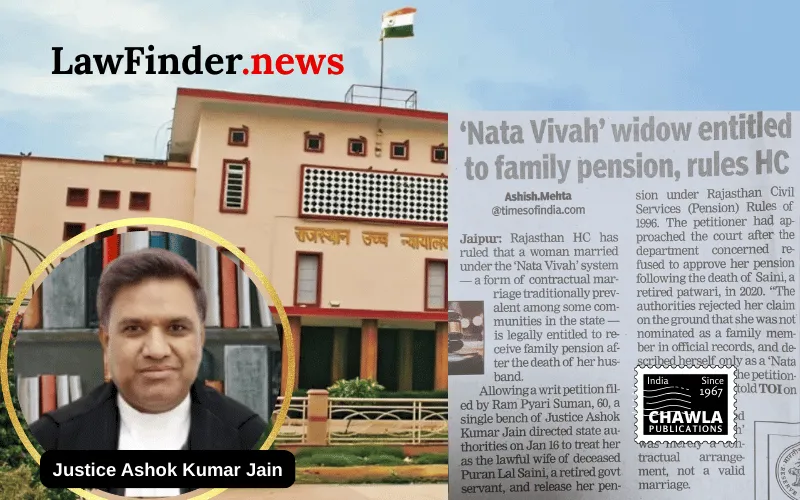
Landmark Judgment Recognizes Customary Marriage for Family Pension Entitlement
In a significant judgment, the Rajasthan High Court, Jaipur Bench, has upheld the entitlement of a woman in a 'Nata Vivah' to claim family pension. Justice Ashok Kumar Jain, presiding over the case of Ram Pyari Suman v. State of Rajasthan, ruled in favor of the petitioner, Ram Pyari Suman, who sought family pension as the recognized "Nata Wife" of deceased government servant Puran Lal Saini.
The court's decision, dated January 8, 2026, was based on the interpretation of Rule 66 of the Rajasthan Civil Services (Pension) Rules, 1996, and the provisions of the Hindu Marriage Act, 1955. The judgment reaffirmed that marriages performed under customary rites, such as 'Nata Vivah', are valid if recognized by the community's customs and are legally admissible for pension claims.
The case arose when Ram Pyari Suman approached the court, asserting her right to family pension after the death of her husband, Puran Lal Saini, a retired government employee. Despite not being nominated in official records, Ram Pyari provided evidence of her marriage to Saini, including an acknowledgment by the deceased in legal proceedings and a daughter born from their union.
Justice Jain noted that the evidence presented, including admissions made by the deceased in previous legal proceedings, conclusively established Ram Pyari as Saini's wife under customary law. The court dismissed the respondents' argument that the absence of her name in government records invalidated her claim, emphasizing the legal recognition of 'Nata Vivah' under Section 7 of the Hindu Marriage Act.
The ruling also highlighted similar precedents, referencing cases like Urmila Devi v. State of Rajasthan and Smt. Soni Devi v. Union of India, where courts had recognized the entitlement of spouses in similar circumstances.
This judgment is expected to have far-reaching implications for the recognition of customary marriages in Rajasthan, providing a legal avenue for spouses in 'Nata Vivah' to claim benefits traditionally reserved for legally documented marriages.
Bottom Line:
Family Pension - A petitioner claiming to be the "Nata Wife" of a deceased government servant is entitled to family pension under Rule 66 of the Rajasthan Civil Services (Pension) Rules, 1996, if the marriage is recognized as valid under customary rites and the deceased had admitted her as his wife in legal proceedings.
Statutory provision(s): Rajasthan Civil Services (Pension) Rules, 1996 Rule 66, Hindu Marriage Act, 1955 Section 7, Evidence Act, 1872 Section 17.
Ram Pyari Suman v. State of Rajasthan, (Rajasthan)(Jaipur Bench) : Law Finder Doc Id # 2839980