Court Declares State Litigation Policy, 2018 as Non-Statutory, Dismissing Quo Warranto Writ
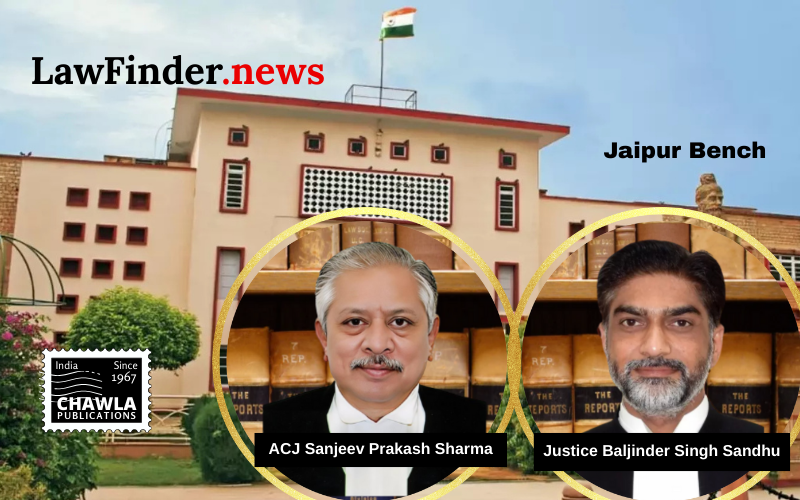
In a significant ruling, the Rajasthan High Court dismissed a special appeal challenging the appointment of an Additional Advocate General, reinforcing that the State Litigation Policy, 2018 does not have statutory force. The Division Bench, comprising Acting Chief Justice Mr. Sanjeev Prakash Sharma and Justice Baljinder Singh Sandhu, upheld the decision of the Single Judge, emphasizing that a writ of quo warranto is not maintainable against appointments made under non-statutory policies.
The appellant, Sunil Samdaria, a practicing advocate, contended that the appointment was invalid as it did not comply with the State Litigation Policy, 2018, which prescribes a minimum of ten years of practice for such appointments. However, the court clarified that the policy is merely a guideline and not enforceable in law, thus not creating any statutory rights or obligations.
The judgment reiterated that the position of Additional Advocate General is a professional engagement rather than a public office, distinguishing it from the role of Advocate General, which is a constitutional post under Article 165 of the Indian Constitution. The court further noted that policy decisions, including appointments, are within the executive's domain and should not be interfered with unless they contravene statutory provisions or involve arbitrariness.
This decision aligns with previous judgments, including those by the Supreme Court, which have consistently held that non-statutory policies cannot be enforced through writ jurisdiction. The court also addressed the appellant's argument regarding the policy's publication in the Gazette, stating that such notification does not confer statutory status.
The Rajasthan High Court's ruling underscores the distinction between statutory rules and policy guidelines, affirming the executive's discretion in appointments and the limited scope of judicial review in such matters.
Bottom Line:
State Litigation Policy, 2018 - Appointment of Additional Advocate General - State Litigation Policy not enforceable in law as it does not have statutory character - Writ of quo warranto not maintainable against appointments made based on non-statutory policy.
Statutory provision(s): Article 226 of the Constitution of India, State Litigation Policy, 2018, Article 165 of the Constitution of India, Section 24 of the Code of Criminal Procedure (Cr.P.C.).
Sunil Samdaria v. State Of Rajasthan, (Rajasthan)(DB)(Jaipur Bench) : Law Finder Doc Id # 2816721