Court dismisses state appeal, affirming son's eligibility under Rajasthan Compassionate Appointment Rules, 1996.
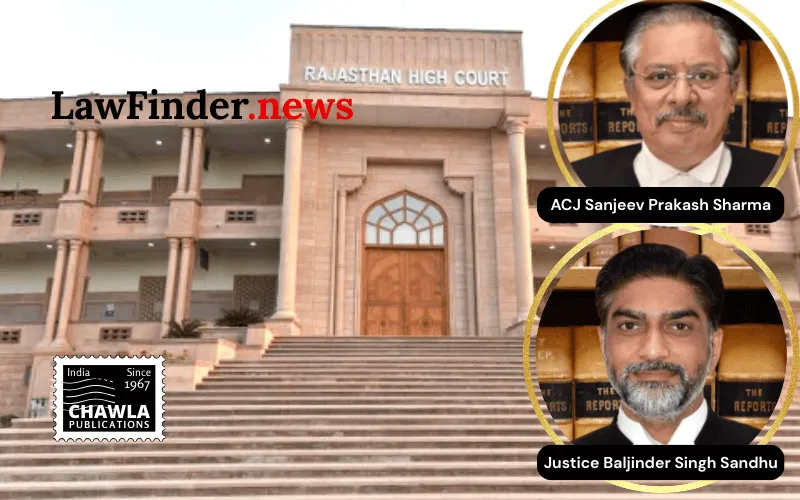
In a significant ruling, the Rajasthan High Court has dismissed an appeal by the State challenging the compassionate appointment of Ashish Saxena, the son of a deceased government servant. The Division Bench, comprising Mr. Sanjeev Prakash Sharma, A.C.J. and Baljinder Singh Sandhu, J., upheld a previous decision by a Single Judge that granted Saxena the appointment, rejecting the State's arguments based on his parents' divorce and his age.
The court examined the application of the Rajasthan Compassionate Appointment of Deceased Government Servant Rules, 1996, particularly the definition of "dependent" under Rule 2(c). The Bench emphasized that the definition clearly includes a son as a dependent, thereby invalidating the State's contention that Saxena's dependency on his father ceased following the divorce of his parents. The judgment underscored that legal dependency is not negated by parental marital status.
Ashish Saxena had filed for compassionate appointment following his father's death in June 2006. Despite meeting the eligibility criteria and submitting his application within the prescribed time, his request was initially denied. The State had insisted on a succession certificate and cited the divorce as reasons for rejection. However, the High Court found these requirements unjustified, noting that Saxena was the legitimate son and thus inherently qualified for consideration under the compassionate appointment scheme.
The court further criticized the State for attributing administrative delays and the time consumed by legal proceedings to Saxena. It noted that his application was within the eligible age limit when filed and that any procedural delays should not penalize the applicant. The Bench found no merit in the argument that his age at the time of the court's decision should affect his eligibility.
The State's appeal also referenced the appointment of the deceased's second wife under the widow quota as a factor against Saxena's claim. The court dismissed this argument, clarifying that the second wife's appointment does not impact Saxena's independent right to appointment as a dependent under the Rules of 1996.
The judgment, delivered on February 25, 2026, concluded with the dismissal of the State's special appeal, reinforcing the Single Judge's order from January 18, 2017. The decision sets a precedent affirming the rights of children of deceased government servants to compassionate appointments, regardless of parental marital status, and emphasizes the responsibility of administrative bodies to process such claims without undue delay.
Bottom Line:
Compassionate appointment - Divorce between the parents of the petitioner does not negate his status as a "dependent" under Rajasthan Compassionate Appointment of Deceased Government Servant Rules, 1996 - Seeking a succession certificate was unwarranted - Delay in administrative process or court litigation cannot be attributed to the petitioner for denial of appointment.
Statutory provision(s): Rajasthan Compassionate Appointment of Deceased Government Servant Rules, 1996
State of Rajasthan v. Ashish Saxena, (Rajasthan)(DB) : Law Finder Doc id # 2862535