Judicial Review Limited to Procedural Aspects; Court Declines to Interfere with Penalty of Withholding Increments
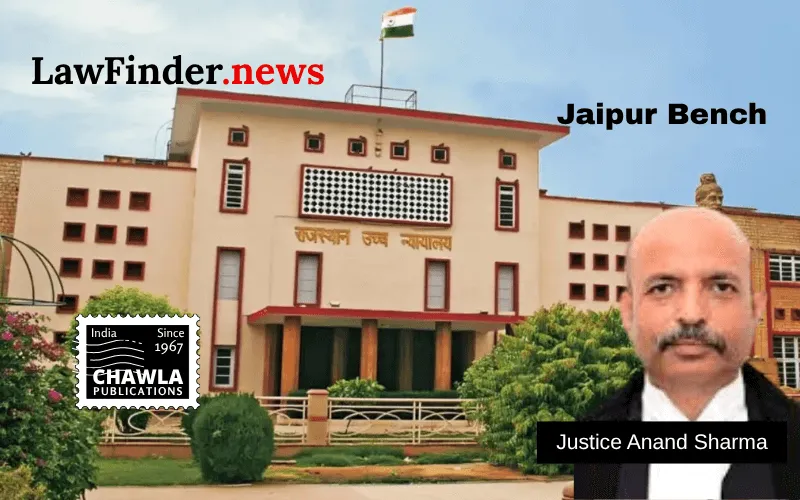
In a significant judgment, the Rajasthan High Court at its Jaipur Bench has dismissed the writ petition filed by Dr. Smt. Hemlata Tetwal, challenging the penalty imposed on her following a departmental enquiry. The petitioner, a Health Officer, faced disciplinary action for willful absence during her probation period. The High Court, presided over by Justice Anand Sharma, affirmed the limited scope of judicial review in disciplinary matters, emphasizing that the court's role is confined to examining the procedural compliance and not the merits of the disciplinary authority's decision.
The court noted that Dr. Tetwal had previously been terminated for her absence but was reinstated following a representation she made, as directed by an earlier court order. Despite her reinstatement, a fresh enquiry was initiated against her for the same period of absence, resulting in a penalty of withholding three annual grade increments with cumulative effect.
Dr. Tetwal contended that the penalty was excessive and disproportionate. However, the court held that disciplinary proceedings are a means for employers to maintain discipline and integrity within the service. The judgment reiterated the principle that courts should not act as appellate authorities in such matters and cannot reassess evidence or substitute their conclusions for those of the disciplinary authority, unless the penalty is shockingly disproportionate or procedurally flawed.
The High Court found that the enquiry had been conducted in accordance with the prescribed rules and principles of natural justice. Adequate opportunities were provided to Dr. Tetwal to present her case, and the findings were based on substantial evidence. The court also rejected her claim of procedural impropriety and upheld the discretion exercised by the disciplinary authority, noting that the penalty did not shock the court's conscience.
The judgment draws heavily on precedents set by the Supreme Court, which limit the scope of judicial intervention in disciplinary actions to cases where there is a significant procedural lapse or the penalty is outrageously disproportionate. The court emphasized that its role is not to question the adequacy of evidence or the proportionality of the punishment unless it is strikingly disproportionate.
In conclusion, the court dismissed Dr. Tetwal's writ petition, affirming the validity of the disciplinary penalty imposed by the department. This decision underscores the judiciary's restraint in interfering with administrative decisions in service matters, provided they adhere to due process and principles of natural justice.
Bottom Line:
Judicial review in disciplinary matters is limited to examining the decision-making process and not the decision itself. High Court cannot reappreciate evidence or substitute its conclusion for that of the disciplinary authority.
Statutory provision(s): Article 226 of the Constitution of India, Rajasthan Civil Services (Classification, Control and Appeal) Rules, 1958