Supreme Court Clarifies Voting Authority for Societies in Landmark Judgment, Apex Court Overturns High Court Decision, Emphasizes Legal Framework for Trustee Authority and Voting Rights
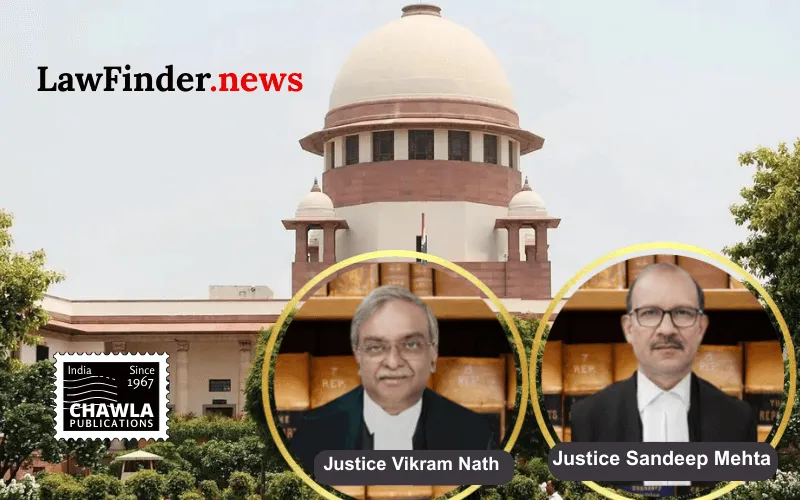
In a significant ruling, the Supreme Court of India has provided clarity on the legal framework governing the exercise of voting rights by societies holding shares in companies. The judgment, delivered by Justices Vikram Nath and Sandeep Mehta, overturns a previous decision by the Calcutta High Court regarding the internal governance and voting authority of societies, including Hindustan Medical Institution, Eastern India Educational Institution, and Belle Vue Clinic, in relation to their shareholding in Birla Corporation Limited (BCL).
The appeals stemmed from disputes over the exercise of voting rights attached to shares held by the three societies in BCL. The societies, registered under the West Bengal Societies Registration Act, 1961, had faced challenges in determining the rightful authority to cast votes during BCL's annual general meetings. The legal contention centered around whether the Board of Trustees or the Managing Committee held the legitimate power to authorize voting on behalf of the societies.
The Supreme Court meticulously examined the societies' by-laws, emphasizing Clause 24, which allows trustees to delegate authority through resolutions backed by a majority, rather than requiring unanimity. The Court underscored that such resolutions, evidenced in writing, are as valid as those passed at a formal meeting of trustees.
Rejecting the High Court's view that trustees must act in complete agreement, the Supreme Court asserted that a majority-backed decision is legally binding, provided it adheres to the societies' governing documents. The Court also clarified that the internal governance structure outlined in the societies' Memorandum of Association and Rules and Regulations establishes the Board of Trustees as the primary authority, with the Managing Committee deriving powers only through explicit delegation.
Moreover, the Supreme Court invalidated the High Court's interim directive that prioritized the vote cast first, irrespective of authority. The Court emphasized that the validity of a vote must be rooted in lawful authorization, not merely the sequence in which it was cast. This interpretation aligns with the statutory provisions under the Companies Act, 2013, and the Companies (Management and Administration) Rules, 2014, which mandate scrutiny of voting authority for non-individual shareholders.
The judgment marks a pivotal moment in defining the legal boundaries of trustee and committee roles within societies, reinforcing the principle that authority, not timing, determines the legitimacy of corporate voting rights.
Bottom Line:
Interpretation of by-laws of societies - Trustees can bind societies through a majority-backed decision evidenced in writing under the by-laws; unanimity is not required. Voting rights must be exercised in accordance with lawful authority traceable to governing documents, not merely by priority in time.
Statutory provision(s): Companies Act, 2013 Section 108, Companies (Management and Administration) Rules, 2014 Rule 20, Indian Trusts Act, 1882 Section 48
Hindustan Medical Institution v. Birla Corporation Limited, (SC) : Law Finder Doc id # 2907080