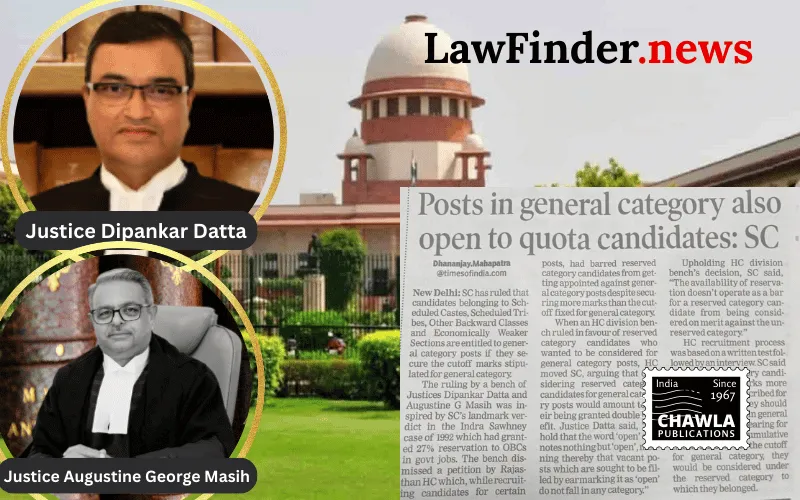
Supreme Court Enforces Merit-Based Inclusion for Reserved Category Candidates in Recruitment Process Sub Supreme Court affirms the principle of meritocracy, directing that reserved category candidates who outperform general category candidates must be considered under the open category.
In a landmark decision, the Supreme Court of India has upheld the principle of merit-based inclusion for reserved category candidates in the context of public employment. The judgment, delivered by a bench comprising Justices Dipankar Datta and Augustine George Masih, addresses a significant issue in the recruitment process, ensuring that merit prevails over categorical reservation when candidates from reserved categories secure marks higher than the general category cutoff.
The case, stemming from a recruitment drive by the Rajasthan High Court for posts in the ministerial establishments, revolved around the treatment of reserved category candidates who scored higher than the general category candidates in a multi-tier recruitment process. The Supreme Court's decision mandates that such candidates must be treated as general/open category candidates in subsequent stages of the selection process, provided they have not availed of any special benefits of reservation.
The court was addressing civil appeals filed by the administration of the Rajasthan High Court, challenging a decision by the Rajasthan High Court that allowed reserved category candidates with higher scores than the general category cutoff to be considered in the open category. The Supreme Court confirmed the High Court's decision, emphasizing that excluding such meritorious candidates from the general category violates constitutional principles of equality and meritocracy.
The judgment clarifies that the open category is not a reserved compartment but is accessible to all candidates based solely on merit. The court highlighted that reserved category candidates who outperform general category candidates should not be confined to their own categories if their merit allows them to qualify for the open category.
Justice Datta, delivering the judgment, noted the legal and constitutional importance of treating more meritorious candidates as belonging to the general category, thereby ensuring that the principle of equality is upheld. The decision further emphasizes that such candidates do not require any migration from their reserved category to the general category, as their merit alone entitles them to be considered in the open category.
The Supreme Court's ruling is expected to have significant implications for future recruitment processes, ensuring that meritocracy is preserved and that reserved category candidates are not unjustly confined to their own slots when their performance qualifies them for the open category.
Bottom Line:
Reserved category candidates who secure marks higher than the cutoff for the General/Open category in a multi-tier recruitment process must be treated as General/Open category candidates for subsequent stages, provided they have not availed any special benefits of reservation. The principle of merit-based inclusion applies throughout the selection process.
Statutory provision(s): Articles 14, 16, 335 of the Constitution of India
Rajasthan High Court v. Rajat Yadav, (SC) : Law Finder Doc Id # 2829028