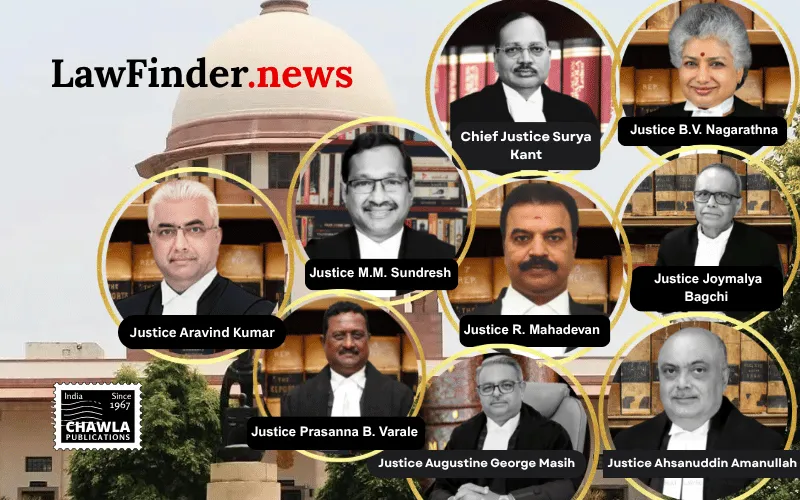
New Delhi, May 12 Right to Freedom of Religion cannot be breached in the name of social reform, the Supreme Court said on Monday, while emphasising that the framers of the Constitution drafted laws keeping in mind the requirements of society and a nine-judge bench cannot "upset" it.
The constitution bench headed by Chief Justice Surya Kant was hearing petitions related to discrimination against women at religious places, including the Sabarimala temple in Kerala, and on the ambit and scope of religious freedom practised by multiple faiths, including Dawoodi Bohras.
B V Nagarathna, M M Sundresh, Ahsanuddin Amanullah, Aravind Kumar, Augustine George Masih, Prasanna B Varale, R Mahadevan and Joymalya Bagchi are also part of the nine-judge bench.
As the hearing commenced on the 14th day, senior advocate Jaideep Gupta, appearing for the Kerala government, submitted that essential aspects of religion cannot be removed in the name of social reforms.
"The important aspect of Hindu religion is the right to worship and it is carried out in consecrated places and if you exclude them, you violate their right,"Gupta said.
Responding to his submission, Justice Nagarathna said,"In the name of social reform, you can't breach the Right to Freedom of Religion under Article 25(1) of the Constitution."
Senior advocate Vijay Hansaria, appearing for one of the intervenors, submitted that in the context of the Sabarimala temple, the whole basis of debarring women from entry is that they are of menstrual age.
"Consider me as a 10-year-old girl. I am going with my family. Menstruation is a taboo and stigma," he said.
Justice Nagarathna then remarked, "It is a taboo, if you view it like that. If you don't consider it a taboo, it is not. The question is how you view it. How a devotee would view it, not how a non-devotee would view it."
Hansaria argued that if a social welfare legislation is made by the State, it has to be upheld and cannot be struck down on the grounds of any religious practice.
The CJI then said, "If the people of this country, through their elected representatives, raise a common voice that this issue requires social reforms, probably the court will accept it as a social reform. But if it is against the wish and will of the people, something is thrusted upon them or, as a rule of gagging them, maybe the court will interfere."
Senior advocate Sanjay Hegde, appearing for rationalists of the Maharashtra Andhashraddha Nirmulan Samiti, submitted that rationalists are people who look at everything, including religion, through the filter of reason.
Hegde said the Constitution itself embeds rationalist values through provisions such as Article 51A(h), which imposes a duty to develop scientific temper and reformist thinking.
Senior advocate Menaka Guruswamy, appearing for late Swami Agnivesh, submitted that the Constitution consciously envisages reform within religions, particularly within Hinduism.
Guruswamy argued that Articles 25 and 26 of the Constitution cannot be interpreted as granting absolute protection to exclusionary practices, especially where such practices conflict with equality and dignity.
Referring to Article 26, she stated that Constitution uses the word "manage" and not "control".
"The use of the word 'manage' in Article 26, instead of 'control,' reflects the constitutional intent to harmonise denominational rights with the individual freedoms protected under Article 25," she said.
Guruswamy said even the right of minorities to manage their institutions under Article 30 are circumscribed as held by a six-judge bench of the Supreme Court.
In response to her submission, Justice Nagarathna said," Because they are minorities, they have certain unique characteristics. Article 30 is there. What was India in the 1950s or late 40s? What was inherited? What were the drawbacks in the society?
"That is one aspect, on which the Constituent Assembly has debated and given its various provisions. But the framers were most conscious of what should be protected, that the civilisation must continue, and therefore, they have come to certain conclusions and Articles are framed in a particular way.
"Today, are we as a nine-judge bench going to upset the civilization is the question? she questioned.
Guruswamy replied that the framers of the Constitution were confident that by reforming faith and religion, they were not upsetting a civilisational balance.
The hearing will resume on Wednesday.
The top court had earlier observed that if individuals start questioning every religious practice or matters of religion before a constitutional court, then there will be hundreds of petitions and every religion will "break" due to this.
A five-judge Constitution bench had lifted a ban that prevented women between the ages of 10 and 50 from entering the Sabarimala Ayyappa temple in a 4:1 majority verdict in September 2018, ruling that the centuries-old Hindu religious practice was illegal and unconstitutional.