New Delhi, Apr 22 Bringing closure to a prolonged legal battle concerning disputed land transactions, the Supreme Court on Wednesday vacated a long-standing status-quo order that had left thousands of innocent homebuyers in the lurch at Thazhambur village in Tamil Nadu.
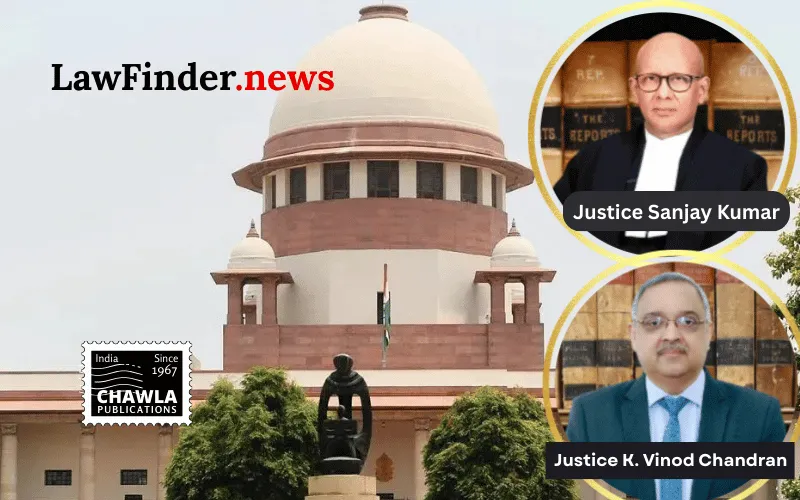
Observing that the state government is "dragging its feet" over the land dispute, a bench of Justices Sanjay Kumar and K Vinod Chandran said a "professed welfare State" cannot attempt to undo land transactions from decades ago at the cost of citizens who have invested their hard-earned money into building houses.
"We may only point out that it is not open to a professed welfare State to seek to turn back the clock after several decades and attempt to undo what was done long ago. All the more so, when much water was allowed to flow under the bridge, whereby third-party rights have been created, involving innocent citizens who have spent their hard-earned monies in the hope of having a roof of their own over their heads," Justice Kumar, authoring the judgment, said.
The verdict said it is not open to the state government to ignore the "plight of such citizens and baldly claim that its lands were illegally parted with, ignoring the fact that such acts, if any, took place long ago".
The court said the government would not be justified in seeking to wipe out transactions that are decades-old, so as to claim title over land that is now in the possession of innocent citizens.
The case pertains to Thazhambur village in Kancheepuram district, where allegations of illegal land allotments to freedom fighters and private individuals surfaced through a public interest litigation (PIL) plea in 2018.
It was also alleged that the land allotted to individuals, some dating back decades, was improperly sold to private developers.
One of the key developers involved was Casagrand Builder Private Limited, which had undertaken large-scale residential projects in the area.
While the Madras High Court had initially allowed the Tamil Nadu government to conduct a "discreet inquiry", the state moved the Supreme Court in 2019, securing a status-quo order.
The state government initiated an inquiry in 2019 through a government order, but the process remained inconclusive despite multiple reports submitted between 2020 and 2021.
For the next six years, that order became a double-edged sword.
While intended to preserve the land during an investigation, the state government effectively blocked hundreds of homeowners from registering their properties and prevented the provision of basic utilities like water and sewerage.
The verdict said the state government has utilised the judicial process to merely prolong the matter, without reaching a conclusion.
"The state government and the authorities cannot be permitted to perpetuate (the status quo) while they drag their feet," the bench said.
The verdict said despite three inquiry reports being submitted between 2020 and 2021, the state has failed to take a final decision, recently appointing yet another committee headed by a retired high court judge.
The verdict brought significant relief to major stakeholders whose projects were stalled.
It included the Army Welfare Housing Organisation, which had built 852 flats for soldiers and officers, with many registrations blocked due to the status-quo order.
According to the verdict, the committee headed by former judge K P Sivasubramaniam has four months to conclude its report, followed by two months for the state cabinet to take a final decision.
The bench ordered the state government to immediately provide water and sewerage connections to the 450 flats in one survey number, saying occupants cannot be denied fundamental amenities due to procedural delays.
Secretary, Government of Tamil Nadu v. S. Raja, (SC) : Law Finder Doc Id # 2887015