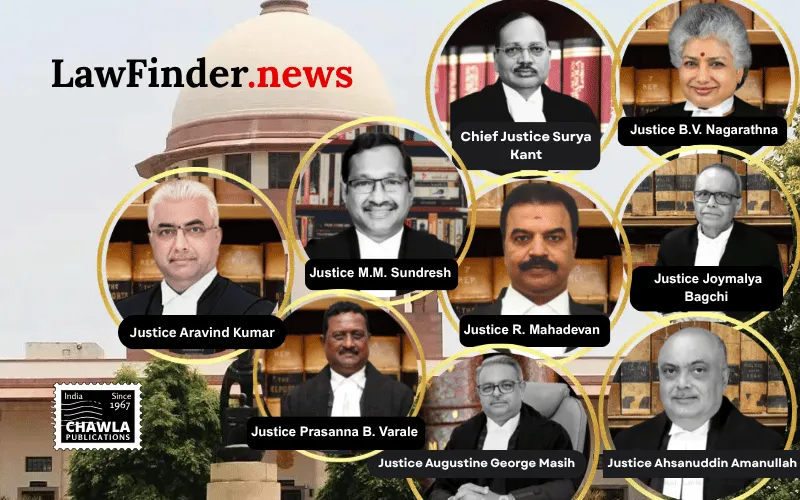
New Delhi, May 5 The Supreme Court on Tuesday grilled an NGO, on whose PIL the apex court had allowed the entry of women of all age groups to the Sabarimala temple and questioned its religious belief and conscience.
A nine-judge constitution bench headed by Chief Justice Surya Kant sought to know what was its objective behind filing of the PIL in 2006 and what business it has on the issue of entry of women to the temple.
The bench also comprising justices B V Nagarathna, M M Sundresh, Ahsanuddin Amanullah, Aravind Kumar, Augustine George Masih, Prasanna B Varale, R Mahadevan and Joymalya Bagchi questioned the locus of the NGO in the matter.
"This is quite serious. The ones who have faith in the deity will perform all that is needed. But someone says that they will break all 'Niyam', which cannot be encouraged by this court. People, who did not have faith and belief in that deity, you are saying, allow them to enter. You are not a true believer," Justice Nagarathna asked advocate Ravi Prakash Gupta, appearing for NGO Indian Young Lawyers Association.
This observation came from the bench while it was hearing petitions regarding discrimination against women at religious sites, including the Sabarimala temple in Kerala, as well as the scope of religious freedom across various faiths.
It questioned Gupta as to how the NGO being a juristic person can claim the right to worship and whether the body comprises of believers.
"Why did you file the PIL? What good has come out of it? How does a juristic body like yours have a belief? This is for an individual. You don't have a conscience," Justice Nagarathna asked Gupta as he submitted that the petition was filed based on news reports about astrologers saying that the shrine was defiled after a woman entered the temple.
CJI Surya Kant said, "Are you the chief priest of the country?"
Justice Kumar also asked Gupta whether any resolution was passed by the NGO and enquired about the president of the body.
Gupta replied that the president of the association at the time was a man named Noushad Ali and he was not aware of any such resolution.
Justice Sundresh interjected and said, "Noushad has played smart... This is nothing but an abuse of the process of law."
Gupta replied that the NGO was the original writ petitioner in the matter and Noushad was only a name-lender president, who was not aware of the litigation.
Referring to earlier submissions, the advocate said the temple's thantri (head priest) has mentioned that young women should not be permitted to enter the temple as the deity doesn't like young ladies.
Justice Nagarathna said, "How are you concerned? What is your business here? Why the petitioner chose to pursue this matter instead of taking up other causes. Young Lawyers Association has no other business? Why can't they work for the welfare of the bar or assist the bench for the legal system of this country? "
"Work for the bar, work for younger members and for their welfare. Those who are struggling in rural areas have difficulty coming to the cities to argue cases. They have brilliant minds. People have come from the villages with different minds..." she said.
Expressing concern over misuse of PIL jurisdiction, the CJI remarked that the PIL should have been dismissed outright as how does a newspaper article give the cause of action to file a PIL?
"It is easy to get articles published for the sake of filing PILs," the bench said.
Justice Nagarathna added, "We have been entertaining PILs in High Courts and in the Supreme Court for the general public who need it. Not for articles being written in newspapers. Public Interest Litigation has now become Private Interest Litigation, Publicity Interest Litigation, Paisa Interest Litigation and Political Interest Litigation. All are called PILs, but we entertain only real and genuine PILs."
She also noted that the CJI receives hundreds of letters daily, questioning whether they could all be turned into PILs.
Gupta submitted that the question of the petitioner's locus was no longer relevant, as the matter had travelled from a three-judge bench to the five-judge bench, which delivered a judgment, finding the matter a worthy cause to entertain.
He also questioned the reference made to the nine-judge bench while relying on certain observations in the Aligarh Muslim University case.
However, the CJI pointed out that the validity of the reference was already upheld by an order passed in February 2020, and the issue cannot be raised again.
Gupta further submitted that Hinduism is an inherently liberal religion which defies precise definition and whether it is described as Sanatana Dharma or Hinduism, it cannot be confined within any single expression, and may even be regarded as an abstract of all religions.
If the Sabarimala judgment is reversed, many regressive practices will be revived, the lawyer added.
The hearing remained inconclusive and would continue on Wednesday.
A five-judge Constitution bench had lifted the ban preventing women between the ages of 10 and 50 from entering the Sabarimala Ayyappa temple in a 4:1 majority verdict in September 2018, ruling that the centuries-old Hindu religious practice was illegal and unconstitutional.