New Delhi, May 6 Observing that it has to be "consistent" and cannot change "colour", the Supreme Court on Wednesday questioned the maintainability of a 40-year old PIL filed by the Central Board of Dawoodi Bohra Community that had raised the question whether the supreme leader of the close-knit community can excommunicate any of its members and if it is constitutionally protected as a religious practice.
The nine-judge Constitution bench is hearing petitions related to discrimination against women at religious places, including the Sabarimala temple in Kerala, and on the ambit and scope of the religious freedom practised by multiple faiths, including Dawoodi Bohras.
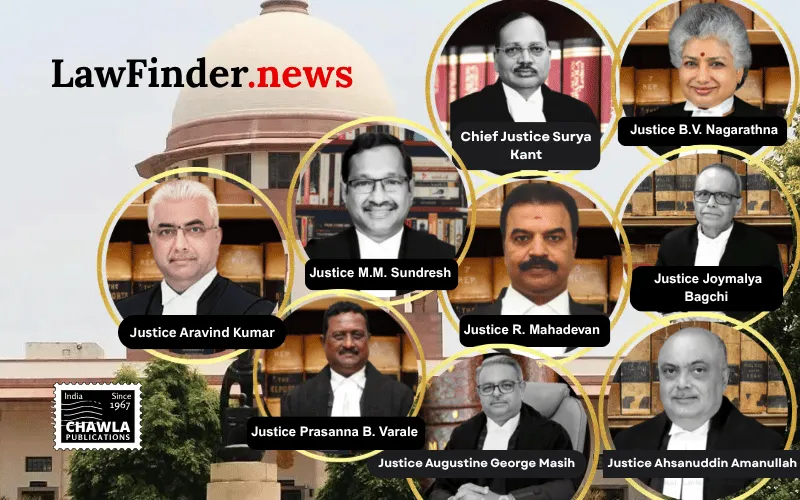
The bench comprises Chief Justice of India (CJI) Surya Kant and Justices B V Nagarathna, M M Sundresh, Ahsanuddin Amanullah, Aravind Kumar, Augustine George Masih, Prasanna B Varale, R Mahadevan and Joymalya Bagchi.
The Central Board of Dawoodi Bohra Community filed a PIL in 1986 seeking the setting aside of a 1962 judgment in the case of Sardar Syedna Taher Saifuddin Saheb which had struck down the Bombay Prevention of Excommunication Act, 1949, making excommunication of any community member illegal.
The 1962 Constitution bench judgment said, "It is evident from the religious faith and tenets of the Dawoodi Bohra community that the exercise of the power of excommunication by its religious head on religious grounds formed part of the management of its affairs in matters of religion and the 1949 Act in making even such excommunication invalid, infringed the right of the community under Article 26(b) of the Constitution."
Senior advocate Raju Ramachandran told the court that he was representing a group of reformist Dawoodi Bohras and one individual whose father, the late Asghar Ali Engineer, was himself a victim of excommunication and whose family has suffered on that account.
Ramachandran submitted that, similar to Parsi women who face religious censure for entering into interfaith marriages, excommunication in Dawoodi Bohras directly impinges upon human dignity.
The senior lawyer told the apex court that the head of the Dawoodi Bohras sect is called the "Dai" which is a sect of Shia Muslims. He said that among Shia Muslims, there are two principal Bohra sects -- Dawoodi Bohras and the Sulemani Bohras.
"The Dai himself is regarded as the representative of the 21st Imam, who is believed to have gone into seclusion. Now, the unique feature of the Dawoodi Bohra faith is that the Dai is the supreme authority.
"Children, upon attaining puberty, take an oath of complete allegiance to the Dai in all matters," Ramachandran said.
He submitted that this is not something unique only to the Dawoodi Bohra community and different faiths may have different forms of religious punishment or discipline to preserve the cohesion of the faith.
"Therefore, the issue is not about the mere imposition of religious discipline, which one may assume every religion requires in order to preserve its flock. The question is about the proportionality of the punishment and its impact upon human dignity," Ramachandran said.
At this juncture, Justice Nagarathna asked, "What is your prayer, you are asking us to set aside a judgment by filing a petition under Article 32 of the Constitution?
Commenting that the Supreme Court has to be "consistent" and cannot change "colour" overnight, Justice Nagarathna asked how Article 32 pleas can be entertained against Constitution bench rulings.
"We are also ultimately conditioned by the hard, rigid discipline on us. That an Article 32 petition comes, you disregard a Constitution bench judgment, you start giving your own judgment, setting it aside.
"A two-judge bench can do it tomorrow. We are concerned, it's a serious matter on practice of this court," Justice Nagarathna said.
Ramachandran replied that he will answer the question, "fairly and squarely" but at a later stage.
Justice Nagarathna then said, "Unless you get over that, how can we hear you on the merits? We cannot entertain a petition on merits unless this is sorted, the decks are cleared."
"Yesterday, we were saying on merits why that writ petition was entertained in Sabarimala. Today, we can't change our colour and say why your writ petition should also be entertained.
"We are the same nine people here. What came out of Sabarimala yesterday? We said, why was it entertained? Today, what we should say?... Both are Article 32 petitions," she said.
The top court had on Tuesday grilled an NGO Indian Young Lawyers Association, on whose PIL the apex court had allowed the entry of women of all age groups to the Sabarimala temple and questioned its religious belief and conscience.
It sought to know what its objective was behind filing the PIL in 2006 and what business it has on the issue of the entry of women to the temple.
Earlier in the day, senior advocate Darius Khambata, who was appearing for a Parsi Zoroastrian woman, argued that an interpretation giving primacy to Article 26(b) over Article 25(1) will annihilate religion and give primacy to Article 26(b) would enable denominational groups to trample upon the rights of individual believers.
Khambata submitted that Article 26(b) is intended to protect the autonomy of a religious denomination against interference by the State.
The hearing will continue on Thursday.
The reference to the nine-judge bench was made by the five-judge bench on the challenge to the 1962 verdict of the Bombay High Court which had upheld the power of excommunication as a protected religious practice.