Supreme Court Clarifies Procedural Safeguards for Complaints Against Public Servants Apex Court mandates affidavits for complaints against public servants, ensuring protection against frivolous allegations under Bharatiya Nagarik Suraksha Sanhita, 2023.
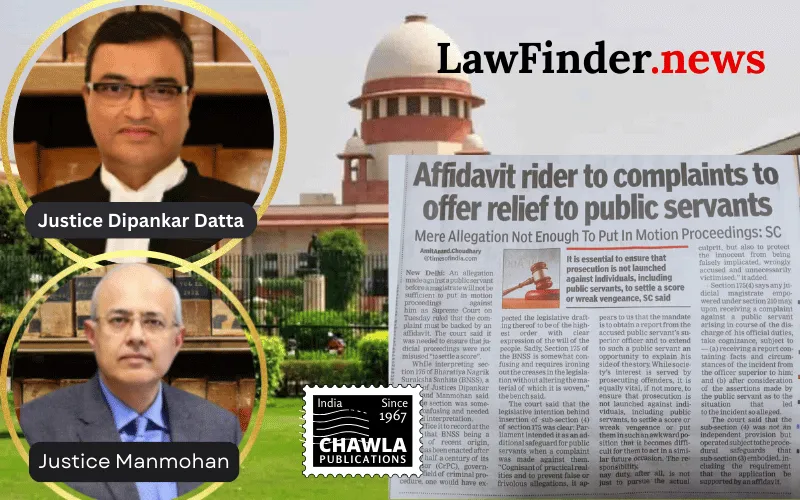
In a landmark judgment, the Supreme Court of India, comprising Justices Dipankar Datta and Manmohan, has provided significant clarity on the procedural requirements for lodging complaints against public servants under the Bharatiya Nagarik Suraksha Sanhita, 2023 (BNSS). The ruling came in the case of XXX v. State of Kerala, where the appellant alleged sexual assault by police officers, questioning the procedural safeguards applicable under Sections 175(3) and 175(4) of the BNSS.
The Court emphasized that sub-section (4) of Section 175, which deals with complaints against public servants, is not a standalone provision but must be read in conjunction with sub-section (3). This interpretation mandates that complaints against public servants must be supported by an affidavit, a crucial procedural safeguard aimed at preventing frivolous or vexatious complaints.
The case arose when the appellant, alleging sexual assault by police officers under the guise of official duties, sought the registration of an FIR. The judicial magistrate had initially called for a report from the superior officer of the accused, following which the appellant approached the High Court. The Single Judge of the High Court intervened, directing the registration of an FIR, but this was overturned by the Division Bench, leading to the appeal in the Supreme Court.
The Supreme Court's judgment elucidates that both sub-sections of Section 175 must be harmoniously interpreted, with sub-section (4) providing additional procedural safeguards. The Court highlighted the importance of an affidavit to substantiate complaints, aligning with the principles established in Priyanka Srivastava v. State of U.P. The judgment further clarifies that this requirement is essential to prevent abuse of the judicial process and to protect public servants from unwarranted allegations.
The Court refrained from delving into the factual aspects of whether the alleged acts by the police officers were in the discharge of official duties, citing the ongoing proceedings before the Judicial Magistrate First Class. It underscored that any declaratory relief sought in such matters should not bypass the procedural framework established by the BNSS.
This ruling marks a significant step in delineating the procedural framework for handling complaints against public servants, balancing the need for accountability with protection against misuse of the legal system.
Bottom Line:
Bharatiya Nagarik Suraksha Sanhita, 2023 (BNSS) - Interpretation of Section 175(3) and 175(4) - Sub-section (4) is not a standalone provision but an extension of sub-section (3), introducing additional procedural safeguards for public servants - Complaints against public servants must be supported by an affidavit.
Statutory provision(s): Bharatiya Nagarik Suraksha Sanhita, 2023 - Sections 175(3), 175(4), 218(1), 333; Article 226 of the Constitution of India.