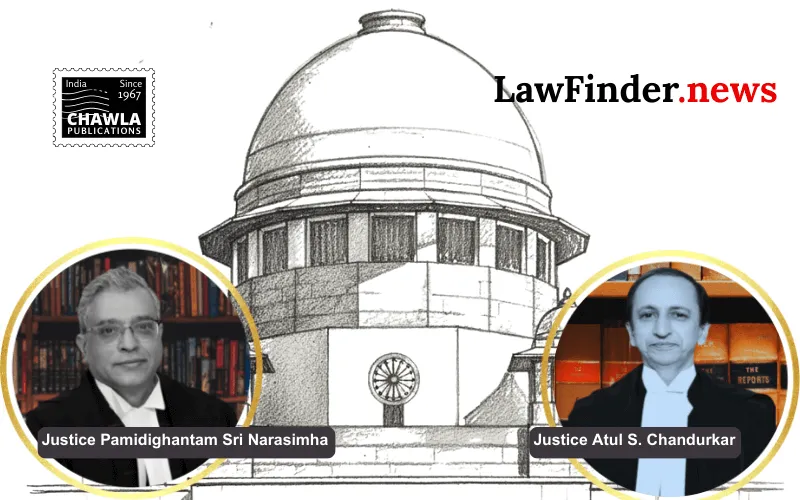
Constitution Bench Rules Governor’s Options Include Assent, Return for Reconsideration, or Reservation for President’s Consideration; Rejects Judicial Timelines and ‘Deemed Assent’
In a landmark judgment delivered on November 20, 2025, a Constitution Bench of the Supreme Court of India has provided a comprehensive opinion on the constitutional powers and discretion of the Governor under Article 200 of the Constitution of India. The Court addressed a Presidential Reference seeking clarity on the Governor’s options when a Bill is presented for assent, the nature of discretion exercised, justiciability of such actions, and related issues.
The reference arose in the backdrop of recent judicial controversies and conflicting Supreme Court judgments, particularly following the decision in State of Tamil Nadu v. Governor of Tamil Nadu (2025), which had raised questions about the Governor’s powers, timelines for assent, and judicial review. The President, invoking Article 143(1), sought the Supreme Court’s opinion on fourteen critical questions concerning Articles 200 and 201, involving the Governor and President’s roles in assenting to State legislation.
Key Findings on Governor’s Options and Discretion
The Court clarified that the Governor has three constitutional options under Article 200 when a Bill is presented: (1) assent to the Bill, (2) reserve the Bill for consideration of the President, or (3) withhold assent and return the Bill to the Legislature with a message requesting reconsideration. This last option is only available if the Bill is not a Money Bill. The Court emphasized that the first proviso to Article 200 restricts rather than expands the Governor’s options, negating any independent power to withhold assent simpliciter.
Crucially, the Court held that the Governor enjoys constitutional discretion in selecting among these three options and is not bound by the aid and advice of the Council of Ministers while exercising his functions under Article 200. This discretion is integral for the Governor to act as a constitutional safeguard and to protect the federal structure of the country.
On Judicial Timelines and ‘Deemed Assent’
Rejecting the imposition of judicially prescribed timelines on the Governor and the President for exercising powers under Articles 200 and 201, the Court observed that the absence of express time limits in the Constitution is deliberate, allowing flexibility depending on the nature and complexity of Bills. It disapproved of the Supreme Court’s earlier decision in State of Tamil Nadu that had set fixed timelines and held that judicial timelines amount to judicial overreach altering constitutional provisions.
The Court ruled out the concept of ‘deemed assent’ to Bills on expiry of any judicial timeline as inconsistent with the constitutional text and doctrine of separation of powers. The judiciary cannot substitute or supplant the functions of the Governor or President by deeming assent.
On Justiciability and Judicial Review
The Supreme Court reaffirmed that the exercise of functions under Articles 200 and 201 is not justiciable at the stage before a Bill becomes law. Courts cannot review or adjudicate the contents of a Bill or the Governor’s decision regarding assent, withholding, or reservation. Judicial review is confined to the law after enactment and cannot interfere in the legislative process prematurely.
However, the Court acknowledged that in cases of prolonged, unexplained, and indefinite inaction by the Governor in exercising his constitutional functions, the judiciary can issue limited directions (mandamus) to the Governor to act within a reasonable time. Such intervention, however, must not extend to merits of the Governor’s discretion.
On Article 361 Immunity
Addressing the question of whether Article 361 provides absolute immunity to the Governor against judicial scrutiny, the Court held that while the Governor enjoys personal immunity from being answerable to courts for acts done in office, this does not bar the courts from examining the validity of such acts, especially on grounds of mala fides or ultra vires actions. The constitutional office of the Governor remains subject to judicial oversight to prevent constitutional inaction.
Additional Clarifications
- - The President is not required to seek the Supreme Court’s advice under Article 143 every time a Bill is reserved by the Governor; the President’s subjective satisfaction is sufficient.
- - The Governor’s assent is essential for a Bill to become law; no law is in force without the Governor’s assent under Article 200.
- - Questions relating to the composition of Supreme Court benches (Article 145(3)) and jurisdiction over Union-State disputes outside Article 131 were declined as irrelevant to the functional nature of the reference.
- - The Court underscored that the Indian Constitution embodies cooperative federalism and a dialogic process between constitutional functionaries, favoring consultation over obstruction.
This detailed opinion is expected to guide the functioning of Governors and Presidents in assent-related matters, reinforcing the federal fabric and constitutional governance while delineating the limits of judicial intervention.
Bottom Line:
The Governor under Article 200 of the Constitution of India has three constitutional options when a Bill is presented-assent, withhold assent and return the Bill with comments (only if it is not a Money Bill), or reserve the Bill for the consideration of the President. The Governor enjoys discretion in exercising these options and is not bound by the aid and advice of the Council of Ministers. The functions exercised by the Governor and the President under Articles 200 and 201, respectively, are not justiciable before the Bill becomes law, and the courts cannot undertake judicial adjudication over the contents of a Bill prior to enactment.
Statutory provision(s): Article 143, Article 200, Article 201, Article 361, Article 163, Article 142, Article 145(3), Article 131, Article 31A, Article 31C, Article 254(2), Article 288(2), Article 360