Bench issues divergent opinions on prior approval requirement for investigating public servants, refers matter for larger Bench consideration
The Supreme Court of India recently delivered a split judgment on the constitutional validity of Section 17A of the Prevention of Corruption Act, 1988, a provision introduced by the 2018 Amendment Act. The provision mandates prior approval from the concerned government authority before any police officer can initiate inquiry or investigation against a public servant for offences related to recommendations made or decisions taken in the discharge of official functions.
The writ petition, filed by the Centre for Public Interest Litigation (CPIL), challenged the provision as violative of Articles 14 and 21 of the Constitution, contending that it shields corrupt public servants and allows the government to selectively grant or refuse sanction, thereby undermining independent investigations and the rule of law. The petitioner relied heavily on the precedents set in Vineet Narain v. Union of India (1998) and Subramanian Swamy v. Director, CBI (2014), where similar executive instructions and statutory provisions requiring prior approval were struck down by the Court.
The Union of India, represented by the Solicitor General, defended the provision, arguing that Section 17A applies to all public servants without arbitrary classification, is narrowly tailored to offences related only to official recommendations or decisions, and includes safeguards such as a time-bound approval process. The government contended that the provision protects honest public servants from frivolous and vexatious complaints that could lead to “policy paralysis,” and noted that investigations ordered by the Lokpal under the Lokpal and Lokayuktas Act, 2013 override Section 17A.
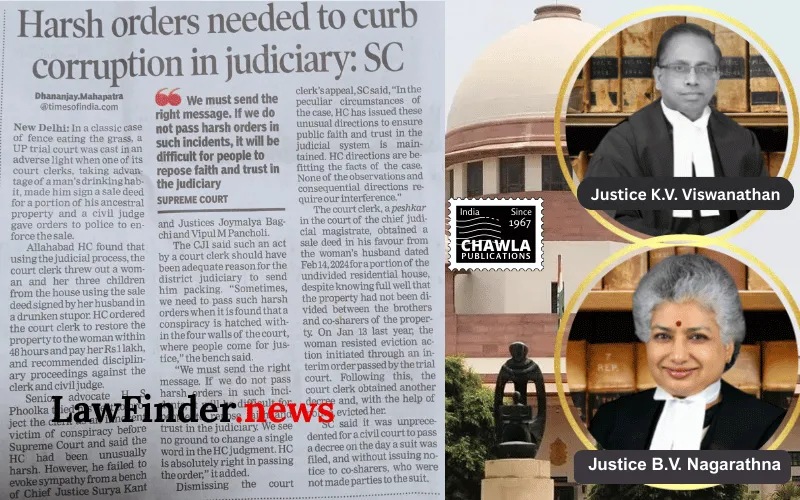
Justice K.V. Viswanathan, in a detailed opinion, upheld the constitutional validity of Section 17A, subject to a reading down that requires the information received under the provision to be forwarded to the Lokpal or State Lokayukta for independent screening. He emphasized that the Lokpal/Lokayukta’s Inquiry Wing, an independent statutory body, should conduct preliminary inquiries to ascertain the prima facie case, and their recommendations must be binding on the government authority deciding on the approval. This interpretation aligns Section 17A with the principles laid down in Vineet Narain and Subramanian Swamy by providing an independent gatekeeping mechanism, thereby balancing protection of honest public servants against misuse of the provision to shield corrupt officials.
On the other hand, Justice B.V. Nagarathna expressed a strong dissent, holding that Section 17A is unconstitutional and an attempt to revive the very provisions struck down in Vineet Narain and Subramanian Swamy. She pointed out that prior approval by the government, which includes officers and ministers who may be involved in the same decision or recommendation under scrutiny, inevitably leads to conflict of interest, bias, and arbitrariness. She argued that Section 17A protects corrupt public servants by foreclosing even preliminary inquiries, thus defeating the object of the Act and violating Article 14’s guarantee of equality before law.
The judgment recognizes the persistent challenge of corruption in India and the need for robust mechanisms to prevent and punish it. Both opinions underscore the importance of protecting honest public servants from frivolous complaints, while ensuring effective and independent investigation of genuine allegations. The majority opinion’s emphasis on involving the Lokpal/Lokayukta as an independent screening authority is aimed at removing the lacunae that led to invalidation of earlier provisions.
Given the divergent views, the Supreme Court has directed the registry to place the matter before the Chief Justice of India for constitution of a larger Bench to reconsider the issues afresh. This case will be a significant milestone in defining the contours of anti-corruption investigations in India, balancing executive efficiency, judicial oversight, and the protection of honest public servants.
Bottom Line:
Prevention of Corruption Act, 1988 Section 17A as introduced by Amendment Act, 2018 - Whether Constitutionally Valid - Split opinion expressed - Matter placed before Chief Justice of India.
Statutory provision(s): Section 17A of the Prevention of Corruption Act, 1988, Section 6A of the Delhi Special Police Establishment Act, 1946, Sections 14 and 20 of the Lokpal and Lokayuktas Act, 2013, Section 19 of the Prevention of Corruption Act, 1988, Article 14 and 21 of the Constitution of India
Centre For Public Interest Litigation v. Union of India, (SC) : Law Finder Doc Id # 2837389