The apex court considers the prolonged duration since the incident and consistent bail status during trial to grant relief.
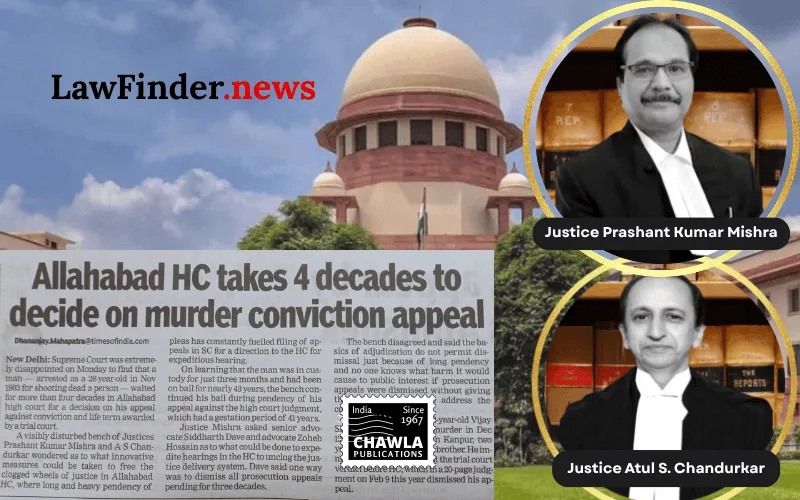
In a significant development, the Supreme Court of India has granted bail to Vijay Singh, who has been embroiled in a legal battle concerning a murder case dating back to 1983. The decision comes after assessing the long passage of time since the incident and the petitioner's consistent bail status during the trial, except for a brief period of three months as an undertrial.
The case revolves around a special leave petition (Criminal) Diary No. 23605 of 2026, where Vijay Singh, the petitioner, sought relief from the Supreme Court against the State of Uttar Pradesh, the respondent. The bench comprising Justices Prashant Kumar Mishra and Atul S. Chandurkar presided over the matter, rendering the decision on June 8, 2026.
The petitioner's counsel, Mr. Siddhartha Dave, emphasized the fact that the incident occurred on November 4, 1983, marking an elapsed period of 43 years. He highlighted that Vijay Singh had been on bail throughout the trial, barring a three-month stint as an undertrial. This argument was pivotal in persuading the court to consider bail, given the prolonged duration and the petitioner's compliance with bail conditions over the years.
The Supreme Court issued a notice to the respondent, with Mr. Yasharth Kant representing the State of Uttar Pradesh, acknowledging receipt of the notice on advance grounds, thereby waiving formal issuance. The court has directed the summoning of the trial court's records, and upon receipt, the matter will be listed for further proceedings. In the interim, Vijay Singh is to be released on bail concerning FIR No. 251 dated November 4, 1983, registered at Police Station Beconganj, District Kanpur, for the offence under Section 302 of the Indian Penal Code, 1860. The bail terms and conditions will be determined by the trial court.
This judgment underscores the Supreme Court's recognition of the passage of time as a critical factor in bail considerations, especially in cases where the petitioner has demonstrated compliance with legal procedures. It brings to light the judicial balance between ensuring justice and acknowledging the practical implications of prolonged legal proceedings.
The case will continue in the Supreme Court following the submission and examination of the trial court records. Legal experts view this judgment as a testament to the evolving perspective of the judiciary in handling decades-old cases, where the passage of time and consistent adherence to legal protocols become substantial grounds for relief.
Bottom Line:
Bail granted to the petitioner considering the long passage of time since the incident (43 years), and the fact that the petitioner was on bail throughout the trial, except for three months as an undertrial.
Statutory provision(s): Section 439 of Criminal Procedure Code, 1973, Section 302 of Indian Penal Code, 1860
Vijay Singh v. State of Uttar Pradesh, (SC) : Law Finder Doc id # 2919854