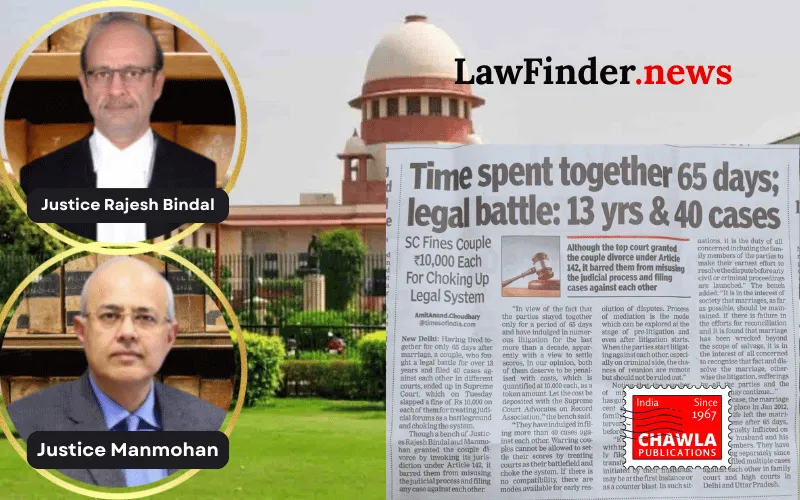
Despite Husband’s Objection, SC Dissolves Marriage of Neha Lal and Abhishek Kumar After Over a Decade of Separation and Numerous Court Cases; Directs Disposal of Pending Matrimonial Cases to Curb Litigation Abuse
In a landmark judgment delivered on January 20, 2026, the Supreme Court of India, comprising Justices Rajesh Bindal and Manmohan, exercised its extraordinary jurisdiction under Article 142 of the Constitution to dissolve the marriage between Neha Lal and Abhishek Kumar, citing irretrievable breakdown of marriage. The decision underscores the Court’s approach toward resolving deeply fractured matrimonial relationships that have become mired in prolonged and acrimonious litigation.
The marriage solemnized on January 28, 2012, lasted only 65 days, after which the parties have been living separately for over a decade. The petitioner-wife, Neha Lal, approached the Supreme Court seeking dissolution of marriage invoking Article 142, which allows the apex court to pass any decree necessary to do complete justice. This application was filed amidst a complex backdrop of more than 40 pending and disposed cases initiated by both parties in various courts including Family Courts, High Courts of Delhi and Allahabad, and District Courts in Ghaziabad and Lucknow.
The respondent-husband, appearing in person, vehemently opposed the divorce, alleging harassment and frivolous litigation by the petitioner. He claimed financial incapacity and contended that the petitioner was well-settled and earning a substantial monthly income. However, the Court found that the parties had failed all attempts at reconciliation, including a mediation effort ordered by the Court, which did not commence effectively.
The Supreme Court referred extensively to its recent Constitution Bench ruling in Shilpa Sailesh v. Varun Sreenivasan (2023), which affirmed that the Court can grant divorce under Article 142 even when one party opposes it, if it is established that the marriage has irretrievably broken down. The Court highlighted factors for consideration, including duration of separation (here over ten years), failure of reconciliation efforts, absence of cohabitation, and the litigation history reflecting a shattered relationship.
The Court emphasized that continuation of formal legal matrimonial status under such circumstances would be unjustified and detrimental to both parties. It also noted that the petitioner had not claimed any alimony, and thus all prior claims stand settled.
Importantly, the Court took a strong stance against the misuse of the judicial process in matrimonial disputes. It observed that the parties had used the courts as battlefields to settle personal scores, filing numerous cases, many of which were dismissed or disposed. The Court underscored the need for mediation and reconciliation at pre-litigation and litigation stages and cautioned against trivial disputes escalating into criminal complaints. It reiterated that police intervention should be a last resort in genuine cases of cruelty and harassment, warning against the mechanical application of provisions such as Section 498A IPC.
The Supreme Court directed that all pending matrimonial cases between the parties be disposed of without further action, except for specific perjury-related proceedings which must continue to preserve the integrity of justice.
Finally, the Court imposed a modest cost of Rs. 10,000 each on both parties, acknowledging the protracted and contentious nature of the litigation, and directed the amount to be deposited with the Supreme Court Advocates on Record Association.
This judgment sets a significant precedent for the exercise of constitutional powers by the Supreme Court to grant divorce on grounds beyond the statutory provisions in the Hindu Marriage Act, especially in cases marked by irretrievable breakdown and prolonged conflict.
Bottom Line:
Dissolution of marriage can be granted under Article 142 of the Constitution of India in cases of irretrievable breakdown of marriage, even if one party opposes the divorce.
Statutory provision(s): Article 142 of the Constitution of India, Section 340 CrPC, Section 125 CrPC (maintained for reference), Hindu Marriage Act, 1955, Section 498A IPC, Section 506 IPC, Sections 323, 504 IPC, Section 379 BNSS, Section 144 BNSS, Protection of Women from Domestic Violence Act, 2005 (PWDV Act)
Step-by-Step Analysis of the Judgment and Its Legal Significance:
1. Background: The marriage lasted for only 65 days, followed by separation for over a decade, during which multiple litigations ensued between the parties, reflecting a completely broken relationship.
2. Legal Issue: Whether the Supreme Court can grant divorce under its constitutional power in Article 142, in the face of opposition by one spouse and absence of statutory ground of irretrievable breakdown in the Hindu Marriage Act.
3. Judicial Precedents: Reliance on Shilpa Sailesh v. Varun Sreenivasan clarified that irretrievable breakdown is not a statutory ground but the Supreme Court can exercise equitable power under Article 142 to dissolve marriage if it is broken beyond repair.
4. Considerations for Irretrievable Breakdown: Factors such as length of separation (here > 10 years), failure of mediation, acrimonious relationship, and absence of cohabitation were key in forming the Court’s opinion.
5. Effect on Pending Litigation: The Court observed that the multiplicity of cases was being used to harass each other and ordered disposal of all pending matrimonial cases except those related to perjury, emphasizing the need to unclog judicial processes.
6. Role of Mediation: The Court reiterated mediation as an essential tool in matrimonial disputes to avoid prolonged litigation and preserve social fabric.
7. Cost Imposition: Both parties were fined modest costs for burdening the judicial system with excessive litigation, signaling judicial displeasure at misuse of courts.
8. Impact: The judgment provides a legal remedy for parties stuck in irretrievably broken marriages, allowing the Supreme Court to intervene for complete justice, and sends a strong message against litigation abuse in matrimonial disputes.
This decision is a crucial development in family law jurisprudence, balancing the need for social harmony, judicial economy, and justice for parties whose marriages have failed irretrievably.
Neha Lal v. Abhishek Kumar, (SC) : Law Finder Doc Id # 2841334