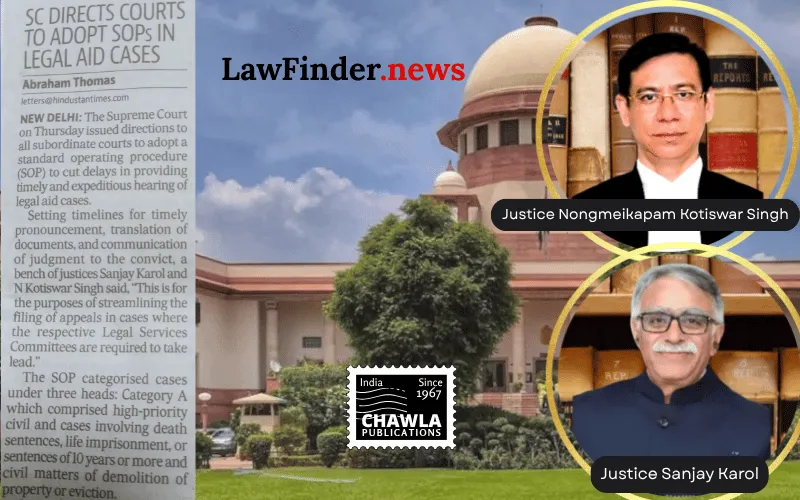
Supreme Court Directs High Courts to Implement SOP for Expedited Legal Aid Procedures and Improved Translator Services
In a landmark judgment aimed at overhauling the legal aid system in India, the Supreme Court of India has issued comprehensive directives to address systemic delays in the provision of legal aid services. The judgment, delivered by a bench comprising Justices Sanjay Karol and Nongmeikapam Kotiswar Singh, underscores the constitutional imperative of legal aid as enshrined under Article 39A, which mandates the State to provide free legal aid to ensure that justice is not denied to individuals due to economic or other disabilities.
The Supreme Court, in its order dated April 16, 2026, has approved a detailed Standard Operating Procedure (SOP) designed to streamline the process of translation, digitization, and transmission of legal documents necessary for filing appeals and Special Leave Petitions (SLPs) in legal aid cases. The SOP, a result of extensive deliberations among key stakeholders, sets binding timelines for various stages of the legal aid process, including translation and document transmission, and emphasizes the need for digital coordination among legal aid bodies and jail authorities.
Key directives from the judgment include the establishment of Monitoring Committees at the High Court and Supreme Court levels to oversee compliance with SOP timelines and quality standards. The Supreme Court has also called for the empanelment of qualified translators and the creation of translator cadres to address deficiencies in translation services, which have been identified as a significant barrier to timely justice.
The judgment further mandates inter-agency communication protocols, including the use of video conferencing between jail authorities and legal aid bodies, to expedite the consent and documentation process for appeals. Additionally, the court has directed the creation of a unified digital platform to facilitate seamless coordination and information exchange among the Supreme Court Legal Services Committee (SCLSC), High Court Legal Services Committees (HCLSCs), and jail authorities.
The Supreme Court has directed all High Courts to consider the SOP on the administrative side and to implement the binding timelines mentioned therein. The court has also emphasized the need for High Courts to examine and take decisions regarding the structural changes necessary for improving translation services.
The judgment is a significant step toward ensuring that the right to legal aid is not just a theoretical entitlement but a practical reality for economically and socially disadvantaged individuals. By mandating systemic improvements and setting clear accountability measures, the Supreme Court aims to enhance access to justice and uphold the constitutional ideals of equality and fairness.
Statutory provision(s): Article 39A of the Constitution, Legal Services Authorities Act, 1987, Standard Operating Procedures (SOP) for translation and transmission of records, Supreme Court Legal Services Committee (SCLSC), National Legal Services Authority (NALSA).
Shankar Mahto v. State of Bihar, (SC) : Law Finder Doc id # 2883771