Apex Court Issues Guidelines to Ensure Peaceful Coexistence and Observance of Religious Rituals Amid Overlapping Events
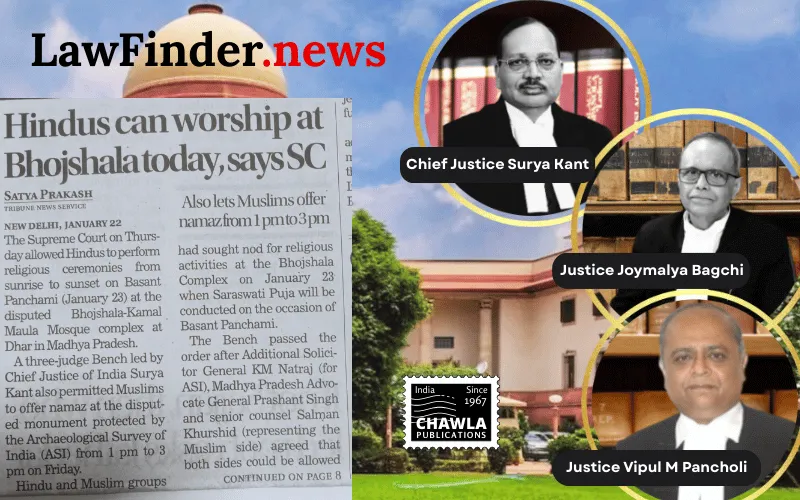
In a landmark decision aimed at fostering communal harmony, the Supreme Court of India has issued directives to facilitate the peaceful coexistence and observance of religious rituals by both Hindu and Muslim communities at the Bhojshala Saraswati Temple-cum-Maulana Kamal Maula Mosque. The judgment, delivered by a bench comprising Chief Justice Surya Kant, Justice Joymalya Bagchi, and Justice Vipul M. Pancholi, addresses the longstanding issue of overlapping religious events and the need for maintaining law and order during such occasions.
The case, filed as a writ petition (Civil) No. 1246 of 2020 by petitioner Ashwini Kumar Upadhyay against the Union of India and others, questioned the interim directions issued by the Madhya Pradesh High Court for a scientific examination of the site. The Supreme Court's attention was particularly drawn to the immediate challenge posed by the overlapping observance of Basant Panchami and the Friday Namaaz on January 23, 2026.
In its order, the Supreme Court reiterated the necessity of ensuring access to the premises for both communities without conflict. It reaffirmed previous directives which allowed the Muslim community to conduct Friday Namaaz between 1 to 3 p.m., and the Hindu community to perform traditional ceremonies on Basant Panchami and every Tuesday from sunrise to sunset.
During the hearing, the court considered the submissions made by senior counsel Salman Khurshid for the petitioner, K.M. Nataraj, Additional Solicitor General of India, and the Advocate General representing the State of Madhya Pradesh. The court was assured by the Additional Solicitor General and the Advocate General that adequate measures would be taken to maintain law and order during the dual observance of religious rituals.
The court's guidelines include the provision of separate spaces within the premises for each community to perform their respective rituals. The Muslim community's approximate number of attendees for Namaaz is to be communicated to the District Magistrate, Dhar, to facilitate the issuance of entry passes and ensure a smooth conduct of events.
The Supreme Court's decision emphasizes mutual respect and tolerance among stakeholders and urges cooperation with state and district authorities to prevent any untoward incidents. The judgment aims to set a precedent for maintaining peace and harmony during religious events that coincide at shared heritage sites.
The interlocutory application concerning this urgent issue has been disposed of with the court's appeal for continued communal cooperation.
Bottom Line:
Directions issued by the Supreme Court to ensure peaceful coexistence and observance of rituals by both Hindu and Muslim communities at Bhojshala Saraswati Temple-cum-Maulana Kamal Maula Mosque during overlapping religious events.
Statutory provision(s): Ancient Monuments and Archaeological Sites and Remains Rules, 1959
Ashwini Kumar Upadhyay v. Union of India, (SC) : Law Finder Doc Id # 2842732