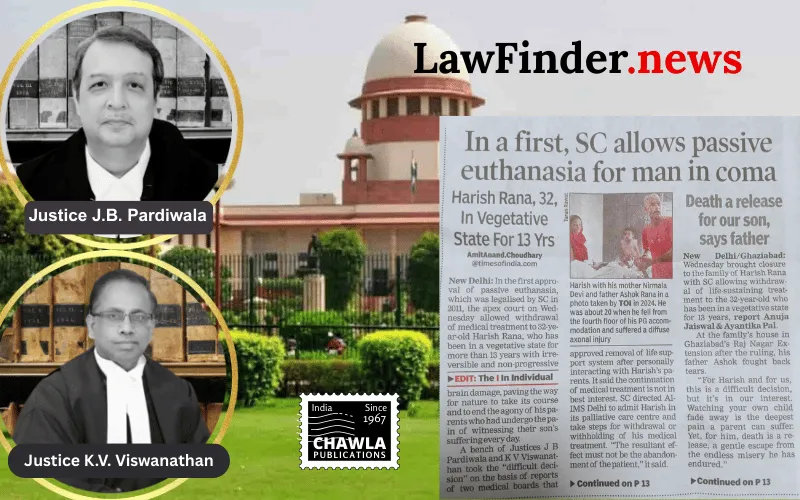
Landmark judgment affirms CANH as medical treatment; withdrawal allowed under 'best interest' principle with robust palliative care safeguards
In a significant verdict delivered on March 11, 2026, the Supreme Court of India, through a Constitution Bench comprising Justices J.B. Pardiwala and K.V. Viswanathan, allowed the withdrawal of Clinically Assisted Nutrition and Hydration (CANH) administered via a Percutaneous Endoscopic Gastrostomy (PEG) tube to a patient in a Permanent Vegetative State (PVS) for over 13 years. The case, Harish Rana v. Union of India, brought to the fore critical issues surrounding passive euthanasia, the legal status of CANH as medical treatment, and the application of the 'best interest of the patient' principle under Article 21 of the Constitution.
The applicant, Harish Rana, suffered a severe traumatic brain injury in 2013 resulting in irreversible brain damage and quadriplegia, rendering him incapable of awareness or interaction with his surroundings. Sustained artificially through CANH and other life-support measures, Harish's family sought permission to discontinue such treatment, contending that it no longer served any therapeutic purpose and compromised his dignity.
The Supreme Court, reaffirming the precedent set in Common Cause v. Union of India (2018) and its 2023 modifications, clarified that CANH constitutes medical treatment, not mere basic care, given its complex administration, associated risks, and medical supervision requirements. This recognition was pivotal in extending the legal framework applicable to withdrawal or withholding of medical treatment to CANH.
Central to the Court’s analysis was the 'best interest' principle, which mandates a comprehensive evaluation of both medical and non-medical factors when deciding on treatment continuation. Medical considerations include futility of treatment, incurability, absence of hope for recovery, and indignity caused by prolonged artificial life support. Non-medical factors encompass the patient’s previously expressed wishes, feelings, beliefs, and values, as well as input from family members and caregivers, often reconstructed through substituted judgment.
In Harish's case, both the Primary and Secondary Medical Boards unanimously opined that continuation of CANH was futile, caused indignity, and was not in his best interests. The family, after years of caregiving and reflection, supported withdrawal to allow natural death with dignity.
The Court emphasized that withdrawal or withholding of treatment must be conducted humanely, accompanied by a structured, medically supervised palliative and end-of-life care plan to minimize pain and preserve dignity. It strongly disapproved the practice of 'discharge against medical advice' as an abdication of medical responsibility.
Further, the Court underscored procedural safeguards embedded in the Common Cause Guidelines, including multi-tiered medical board evaluations, written consent of patient's next of kin or guardian, and limited judicial intervention only upon disagreement. It also stressed the need for timely nomination of medical practitioners by Chief Medical Officers (CMOs) to avoid delays and called upon the Union Government and State authorities to prepare panels for such nominations.
Recognizing the legislative vacuum in India regarding end-of-life care and euthanasia, the Supreme Court urged Parliament to enact comprehensive legislation to provide clarity and certainty. Until then, the Court’s guidelines remain the governing legal framework.
The judgment poignantly acknowledged the profound love and endurance of Harish’s family, who have cared for him over thirteen years. It concluded by underscoring that the decision does not equate to choosing death but reflects compassion in not artificially prolonging life when treatment no longer heals or improves, thereby upholding the right to live and die with dignity.
Bottom Line:
Passive euthanasia - Withdrawal of life-sustaining treatment for a person in permanent vegetative state is permissible under the guidelines laid down in Common Cause v. Union of India (2018), as modified in 2023, provided it is in the best interest of the patient and supported by medical boards and family consent. Clinically Assisted Nutrition and Hydration (CANH) administered through medical devices such as PEG tubes constitutes medical treatment, and its withdrawal or withholding in cases of patients in Permanent Vegetative State (PVS) is permissible under Article 21 of the Constitution of India when it is in the best interests of the patient.
Statutory provision(s): Constitution of India, Article 21; Common Cause Guidelines (2018, 2023); Indian Penal Code Sections 306, 309 (referenced); Mental Capacity Act 2005 (UK) (referenced); Law Commission Reports 196 and 241 (referenced)
Harish Rana v. Union of India, (SC) : Law Finder Doc id # 2864455