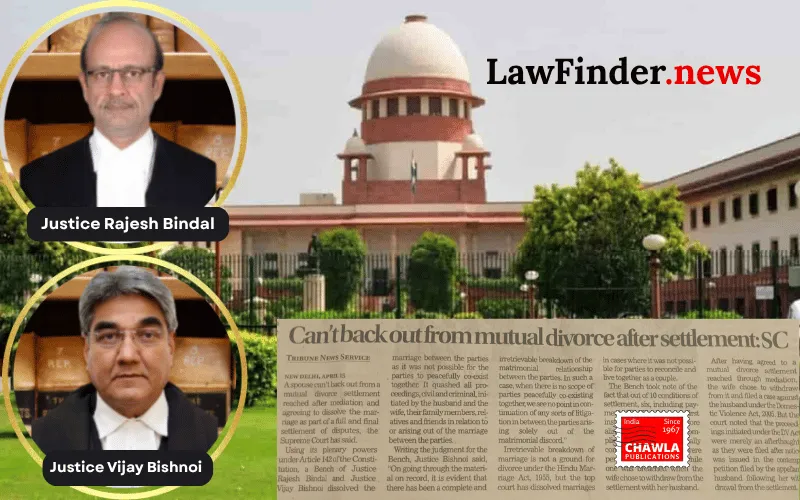
Settlement Agreement in Matrimonial Dispute Upheld; Supreme Court Utilizes Article 142 for Complete Justice
In a significant ruling, the Supreme Court of India has quashed a domestic violence complaint filed by Ruchika Rathi against her husband, Dhananjay Rathi, while granting a decree of divorce citing the irretrievable breakdown of marriage. The decision, delivered on April 13, 2026, by Justices Rajesh Bindal and Vijay Bishnoi, underscores the sanctity of mediated settlement agreements and emphasizes the court’s power under Article 142 of the Constitution to ensure complete justice.
The couple, married since February 2000, faced matrimonial discord leading to separation in 2022-23. Following mediation, a settlement agreement was reached in May 2024, proposing mutual divorce under the Hindu Marriage Act, 1955, and outlining financial and property arrangements. The agreement, however, fell apart when Ruchika withdrew consent for the divorce, alleging non-fulfillment of additional verbal assurances by Dhananjay regarding jewelry and gold worth crores, which were not documented in the settlement.
The Supreme Court, after thorough examination, found these allegations unsubstantiated and highlighted the importance of adhering to the terms of a mediated settlement. The court criticized the initiation of domestic violence proceedings as an abuse of the judicial process, noting the lack of specific allegations and the timing of the complaint, which coincided with the initiation of contempt proceedings by Dhananjay.
Invoking Article 142, the Supreme Court dissolved the marriage, acknowledging the irretrievable breakdown and emotional deadlock between the parties. The court directed compliance with the settlement terms, including financial transactions and property transfers, while imposing a bar on future litigation related to the matrimonial discord.
This judgment reaffirms the court's commitment to upholding mediated agreements and using its constitutional powers to deliver justice in complex marital disputes, ensuring that parties cannot whimsically deviate from mutually agreed terms.
Bottom Line:
Matrimonial Dispute - Settlement Agreement reached during mediation is binding on both parties unless procured by fraud, force, or undue influence. Proceedings initiated under the Domestic Violence Act after resiling from such a settlement, without credible allegations, amount to abuse of the judicial process. Irretrievable breakdown of marriage is a valid ground for dissolution under Article 142(1) of the Constitution.
Statutory provision(s): Protection of Women From Domestic Violence Act, 2005; Hindu Marriage Act, 1955; Article 142 of the Constitution of India; Bharatiya Nagarik Suraksha Sanhita, 2023
Dhananjay Rathi v. Ruchika Rathi, (SC) : Law Finder Doc id # 2882004