Apex Court Upholds Policy Against Naming Villages After Individuals to Preserve Communal Harmony
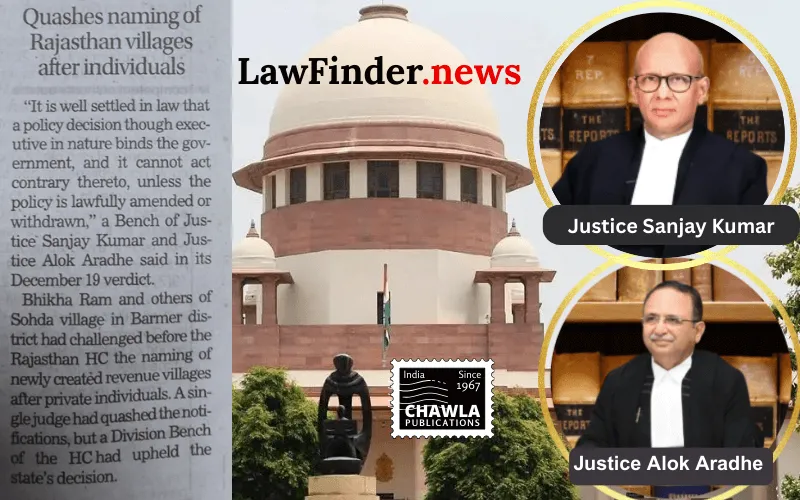
In a landmark decision, the Supreme Court of India has quashed the notification issued by the Rajasthan State Government that created new Revenue Villages named Amargarh and Sagatsar, derived from the names of individuals. The judgment, delivered on December 19, 2025, by Justices Sanjay Kumar and Alok Aradhe, reinstates the earlier order of the Rajasthan High Court, emphasizing the binding nature of policy decisions concerning the naming of Revenue Villages.
The controversy arose when the State Government, exercising its powers under Section 16 of the Rajasthan Land Revenue Act, 1956, issued a notification on December 31, 2020, establishing several new Revenue Villages. Among these were Amargarh and Sagatsar, which were challenged for being named after individuals, contrary to the State Government's policy outlined in a circular dated August 20, 2009. This circular mandates that names of Revenue Villages should not be based on any person, religion, caste, or sub-caste to maintain communal harmony.
The appellants, Bhika Ram and another resident of Sohda village, contended that the notification violated the policy decision and was, therefore, arbitrary and violative of Article 14 of the Constitution, which guarantees equality before the law. The Supreme Court concurred, stating that policy decisions, though executive in nature, bind the Government and cannot be contravened without lawful amendment or withdrawal.
The judgment comes after a series of legal proceedings initiated by the appellants, who first approached the High Court with a writ petition challenging the notification. A Single Judge of the High Court had previously quashed the notification concerning Amargarh and Sagatsar, a decision later overturned by a Division Bench. The Supreme Court's ruling reinstates the Single Judge's order, allowing the Government to rename the villages in accordance with the law.
This decision is expected to have widespread implications for administrative practices across India, reinforcing the principle that policy decisions must be adhered to unless appropriately amended. The judgment serves as a reminder of the importance of maintaining communal harmony and the binding nature of policy decisions in governmental actions.
Bottom Line:
State Government cannot act contrary to its own policy decisions, and names of Revenue Villages should not be based on any person, religion, caste, or sub-caste to maintain communal harmony.
Statutory provision(s): Rajasthan Land Revenue Act, 1956 Section 16, Article 14 of the Constitution
Bhika Ram v. State of Rajasthan, (SC) : Law Finder Doc Id # 2824386