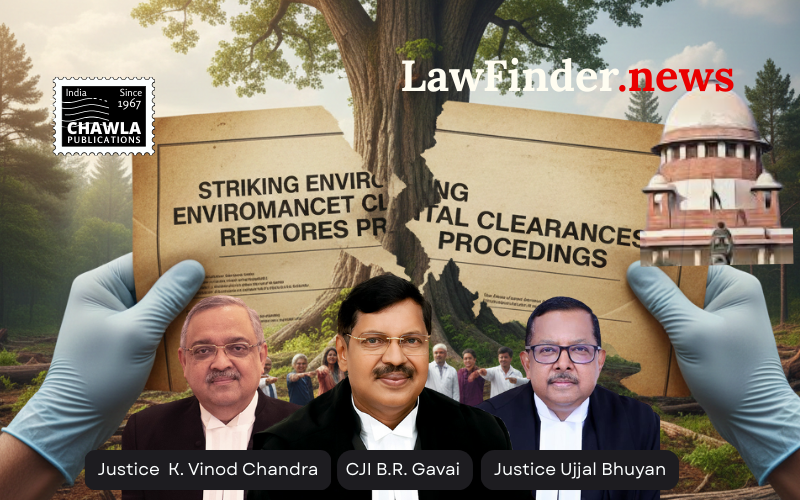
In a landmark review, SC revisits its May 2025 verdict on environmental clearance notifications, balancing environmental jurisprudence with public interest and developmental realities.
The Supreme Court of India has taken a significant step by recalling its earlier judgment dated 16th May 2025, which had struck down the 2017 Notification and 2021 Office Memorandum (OM) issued by the Ministry of Environment, Forest and Climate Change (MoEF&CC) permitting ex-post facto Environmental Clearances (ECs). The decision came on a review petition filed by the Confederation of Real Estate Developers of India (CREDAI), challenging the final order in the consolidated writ petitions including Vanashakti v. Union of India.
The 2017 Notification and the 2021 OM had created a regulatory framework for granting ECs retrospectively to projects that commenced or expanded without prior clearance under the Environment Impact Assessment Notification, 2006. The earlier judgment had declared these instruments illegal, emphasizing that ex-post facto ECs are alien to environmental jurisprudence and that projects without prior EC must be stopped and demolished, regardless of penalty payment.
However, upon a detailed re-examination, the Supreme Court acknowledged that certain vital paragraphs and precedent judgments were not properly considered in the May 2025 verdict. Particularly, the judgments in D. Swamy v. Karnataka State Pollution Control Board and Pahwa Plastics Private Limited v. Dastak NGO, which had upheld the validity of the 2017 Notification and 2021 OM, were not brought to the Court’s attention earlier.
The Court observed that the environmental protection laws do not absolutely prohibit ex-post facto ECs and that in exceptional circumstances, where the adverse consequences of denying such clearance outweigh the benefits of regularization, ex-post facto EC may be granted. The Court further noted that the principle of “polluter pays” and heavy penalties for violations serve as deterrents against non-compliance.
Significantly, the Court took cognizance of the practical and public interest implications of its earlier order, which threatened the demolition of several large-scale government and public sector projects, including a 962-bed AIIMS hospital in Odisha, a greenfield airport in Vijayanagar, Karnataka, and common effluent treatment plants-all constructed at a cost of approximately Rs. 20,000 crore. The Court recognized that demolition would not only waste public funds but also cause environmental harm through debris and pollution.
The Supreme Court reiterated the need for a balanced approach that protects the environment while safeguarding public interest, economic considerations, and ongoing development projects. It recalled the earlier judgment, restored the writ petitions and civil appeals, and directed that the matter be placed before the Chief Justice of India for further orders.
The review judgment also underscored the importance of judicial discipline, clarifying that when conflicting views emerge from coordinate Benches, the correct course is to refer the matter to a larger Bench. The Court held that the earlier May 2025 judgment was rendered per incuriam (in ignorance of binding precedents) and hence not binding.
While the Court has allowed the review petition, a dissenting opinion cautioned that no case for review was made out and emphasized that the principle of prior EC as mandatory remains settled law. The divergent views highlight the complex interplay between environmental protection and developmental exigencies in India’s evolving jurisprudence.
Bottom Line:
The Supreme Court recognized that while prior Environmental Clearance (EC) is mandatory and ex post facto EC is generally alien to environmental jurisprudence, exceptional circumstances may warrant grant of ex post facto EC to avoid disproportionate hardship and protect public interest, balancing environmental protection with economic and social considerations.
Statutory provision(s): Environment (Protection) Act, 1986 - Sections 3, 15, 19; Environment (Protection) Rules, 1986 - Rule 5; Environment Impact Assessment Notification 1994; Environment Impact Assessment Notification 2006; General Clauses Act, 1897 - Section 21
This news report summarizes the Supreme Court’s nuanced reconsideration of environmental clearance norms, reflecting the judiciary’s attempt to balance strict environmental safeguards with practical developmental needs, while upholding principles of judicial propriety and precedent.