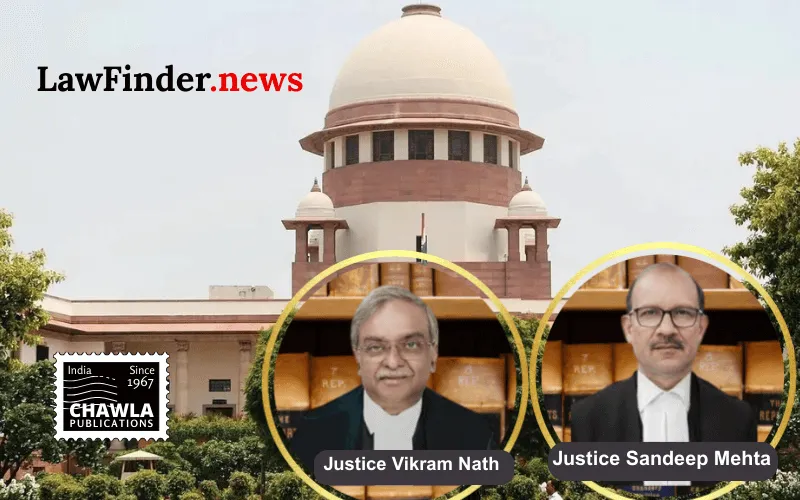
Court Upholds Executive's Domain in Policy Decisions on Public Holidays, Dismisses PIL
In a landmark decision, the Supreme Court of India has dismissed a Public Interest Litigation (PIL) filed by the All India Shiromani Singh Sabha, seeking the declaration of Guru Gobind Singh Ji's Prakash Parv as a nationwide gazetted holiday. The judgment was delivered by Justices Vikram Nath and Sandeep Mehta on March 17, 2026.
The petitioner, a registered charitable and religious organization, argued that the current framework for declaring public holidays in India lacks statutory foundation and is governed by executive instructions, leading to arbitrary and discriminatory practices. They contended that the absence of a uniform policy undermines the objectivity expected in a pluralistic secular society, marginalizing significant cultural and historical observances like the Prakash Parv of Guru Gobind Singh Ji.
Senior Advocate Vikas Singh, representing the petitioner, emphasized the contributions of Guru Gobind Singh Ji to India's spiritual and moral fabric, advocating for his birth anniversary to be recognized as a nationwide public holiday. Singh argued that a transparent and uniform policy is necessary to ensure fairness and consistency in the declaration of public holidays, citing foreign jurisdictions with statutory frameworks governing such matters.
However, the Supreme Court held that the declaration of public holidays is a policy decision involving administrative, economic, and governance considerations, which lie within the domain of the executive. The court noted the diverse sociocultural practices across India and emphasized that expanding the list of gazetted holidays could adversely impact governance and public productivity.
The court also addressed the petitioner's reliance on Article 14 and Article 25 of the Constitution, stating that Article 14 does not mandate absolute uniformity in policy matters where differentiation is based on rational considerations. Furthermore, Article 25's guarantee of freedom of religion does not extend to seeking State recognition of religious occasions as nationwide public holidays.
The judgment highlighted the potential implications of granting such relief, cautioning that it could open the floodgates to similar claims from various sections of society, resulting in an impractical expansion of public holidays.
In conclusion, the Supreme Court dismissed the writ petition, underscoring the executive's prerogative in matters of policy determination and recognizing the sentiment underlying the petition without furnishing a justiciable basis for issuance of a writ under Article 32 of the Constitution.
Bottom Line:
Matters of policy determination, including declaration of public holidays, lie within the domain of the executive and are not amenable to judicial determination under Article 32 of the Constitution of India.
Statutory provision(s): Article 32, Article 14, Article 25
All India Shiromani Singh Sabha v. Union of India, (SC) : Law Finder Doc id # 2871210