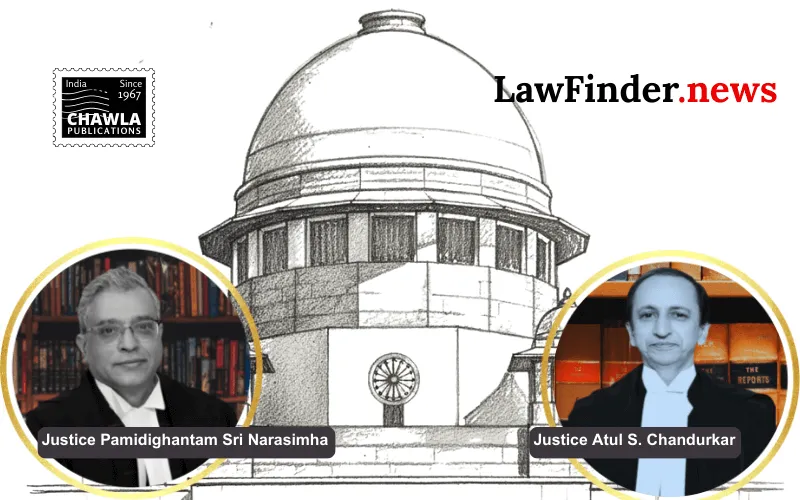
SC underscores the gravity of serious offences and stresses that High Courts must exercise extreme caution before granting bail to convicted accused pending appeal; emphasizes need for clarity and detailed reasoning in judicial orders
In a significant ruling delivered on September 7, 2021, the Supreme Court of India quashed and set aside the Allahabad High Court’s orders granting bail to four accused convicted in the murder case of Kripa Shankar Shukla. The accused—Swaminath Yadav, Surendra Kumar Pandey, Jhingur Bhar, and Vikrama Yadav—were convicted by the trial court for offences under Sections 302 (murder), 149 (unlawful assembly), 201 (causing disappearance of evidence), read with Section 120B (criminal conspiracy) of the Indian Penal Code (IPC), and sentenced to life imprisonment.
The Supreme Court’s decision came on appeals filed by the victim’s widow, Shakuntala Shukla, challenging the High Court’s bail orders passed in October and December 2018. The High Court had allowed bail to the accused pending their criminal appeals, a move strongly contested by the victim’s side and the State. The apex court’s bench comprising Justices Dr. Dhananjaya Y. Chandrachud and M.R. Shah observed that the High Court failed to properly appreciate the seriousness of the offences, the conduct of the accused, and the trial court’s detailed findings before granting bail.
The case arose from the brutal murder of Kripa Shankar Shukla whose body was found in a well in Ballia district in October 1995. Despite early police investigations being flawed and attempts to derail the investigation—including false reporting by the investigating officer and misreporting by the post-mortem doctor—the Special CB-CID investigation led to the conviction of the accused. The trial court also convicted the erring police officer and doctor for their roles in obstructing justice.
The Supreme Court heavily criticized the High Court’s bail orders for lacking clarity and detailed reasoning. It pointed out that the orders did not adequately reflect the submissions of the prosecution or the State, failed to address the threats given by the accused to prosecution witnesses, and overlooked the criminal history involving intimidation (Sections 504 and 506 IPC). The bench stressed that once accused are convicted for serious offences such as murder, the presumption of innocence no longer applies, and courts must be very cautious in granting bail pending appeal.
Further, the Supreme Court elaborated on the essential qualities of a judicial judgment, underscoring that a judgment must clearly state the facts, issues, submissions, legal reasoning, and the final relief granted. It lamented the “total lack of clarity” in the High Court’s orders, which muddled submissions, findings, and reasoning, thereby complicating appellate review.
Consequently, the Supreme Court directed that the accused surrender forthwith to serve their sentences and authorized the trial court to issue warrants for their arrest if they fail to comply. The apex court also mandated that the High Court decide the pending appeals on their own merits without being influenced by the observations made in this judgment.
This judgment reinforces the principle that bail in serious offences, particularly post-conviction, must be granted sparingly and only on cogent grounds, ensuring that the rights of victims and the integrity of the criminal justice system are preserved.
Statutory provisions
Indian Penal Code, 1860 - Sections 147, 149, 302, 201, 218, 120B, 504, 506; Code of Criminal Procedure, 1973 - Section 389
Shakuntala Shukla v. State of Uttar Pradesh (SC) : Law Finder Doc Id # 1875229