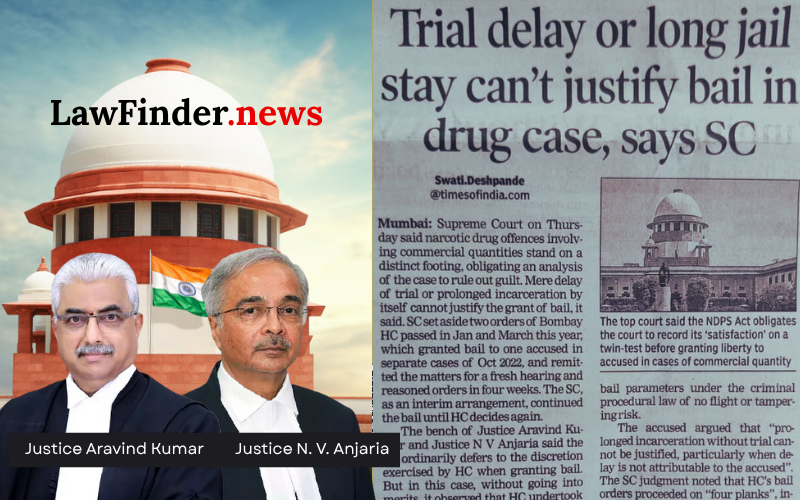
Apex Court Remands Case for Fresh Consideration, Citing Non-compliance with Statutory Requirements under NDPS Act
In a significant ruling, the Supreme Court of India has set aside the Bombay High Court's bail orders granted to Vigin K. Varghese, accused in a high-profile narcotics case involving the seizure of commercial quantities of cocaine. The apex court found that the High Court failed to adhere to statutory requirements under Section 37 of the Narcotic Drugs and Psychotropic Substances Act, 1985, which mandates a stringent scrutiny of bail applications in drug-related offences.
The case revolves around the seizure of approximately 50.232 kilograms of cocaine imported from South Africa, linked to Vigin K. Varghese, who is alleged to have played a pivotal role in the import and logistics of the contraband. The Directorate of Revenue Intelligence (DRI) apprehended Varghese, who has been in custody since October 2022. Despite the gravity of the charges, the Bombay High Court had previously granted bail, citing factors such as lack of antecedents and prolonged custody without trial.
The Supreme Court, comprising Justices Aravind Kumar and N. V. Anjaria, highlighted the High Court's oversight in not adequately considering the 'twin conditions' under Section 37(1)(b) of the NDPS Act, which require the court to be satisfied that there are reasonable grounds for believing that the accused is not guilty of such offence and that he is not likely to commit any offence while on bail.
The prosecution, represented by the Union of India, argued that the High Court's decision was contrary to the established legal framework, emphasizing the presence of incriminating evidence such as call records and statements implicating Varghese in the narcotics trade. The Supreme Court noted that the High Court did not engage with these critical aspects, nor did it address the respondent's alleged involvement in an earlier drug seizure.
In its judgment, the Supreme Court remanded the matter back to the Bombay High Court for a fresh appraisal, directing it to consider the statutory parameters and the material on record before arriving at a decision. The court also underscored the need to harmonize the rigorous statutory conditions with the right to personal liberty under Article 21 of the Constitution.
The Supreme Court's ruling emphasizes the critical balance between individual liberties and societal interests in cases involving serious offences such as drug trafficking. Until the High Court re-evaluates the bail plea, Varghese will continue to enjoy the benefits of the previously granted bail, albeit with strict conditions to prevent any potential tampering with evidence or influence on witnesses.
Bottom Line:
NDPS Act - Bail order by High Court set aside due to non-compliance with statutory requirements under Section 37, including lack of analysis of twin conditions and antecedents. Case remitted to High Court for fresh consideration.
Statutory provision(s): Narcotic Drugs and Psychotropic Substances Act, 1985 Sections 35, 37; Constitution of India, 1950 Article 21
Union of India v. Vigin K. Varghese, (SC) : Law Finder Doc Id # 2807722