Landmark Judgment Affirms Constitutional Supremacy, Declares Minimum Age and Tenure Provisions Arbitrary, and Directs Formation of National Tribunals Commission
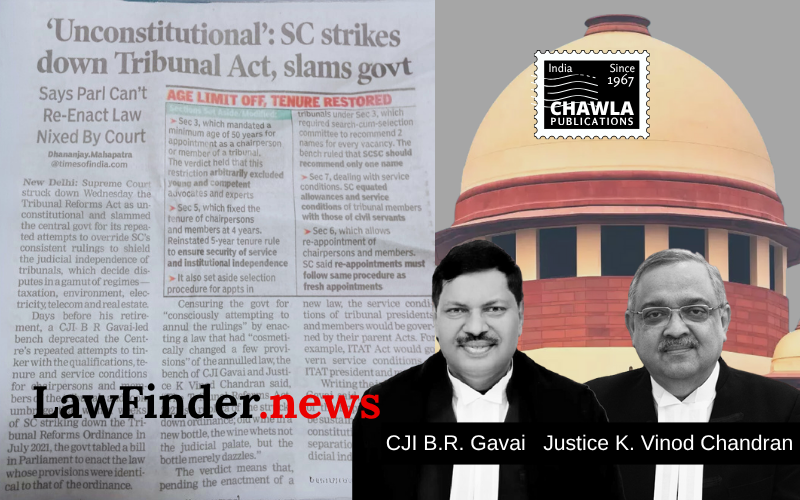
In a landmark judgment delivered on November 19, 2025, the Supreme Court of India, in a two-judge bench comprising Chief Justice B.R. Gavai and Justice K. Vinod Chandran, struck down key provisions of the Tribunal Reforms Act, 2021 (“Impugned Act”), holding them unconstitutional for violating the basic structure of the Constitution, particularly the principles of separation of powers and judicial independence. The judgment, pronounced in the consolidated writ petitions filed by the Madras Bar Association and others, reiterates and reinforces the constitutional mandate that all organs of the State, including Parliament and the Executive, are bound by and must respect the supremacy of the Constitution as interpreted by the judiciary.
The dispute arose from challenges to the Impugned Act’s provisions that imposed a minimum age limit of 50 years for appointment as Chairperson or Member of tribunals, curtailed tenure to four years with upper age caps, and empowered the Central Government with excessive control over appointments, salaries, allowances, and service conditions of tribunal members. The Act also mandated a Search-cum-Selection Committee (SCSC), dominated by executive nominees, to recommend panels of two names per vacancy, with the Government required to decide preferably within three months. The petitioners contended that these provisions diluted judicial independence, nullified binding Supreme Court directions, and amounted to an impermissible legislative override of judicial pronouncements.
The Court, after extensively tracing the jurisprudence on tribunals from S.P. Sampath Kumar (1987) through successive Madras Bar Association judgments (2010, 2014, 2015, 2021, and 2022), reaffirmed that tribunals, as constitutional adjudicatory bodies exercising judicial or quasi-judicial functions, must conform to the highest standards of independence, impartiality, and competence akin to courts. The Court underscored that judicial appointments and tenure are critical to institutional independence and must be insulated from executive or legislative encroachment.
The judgment emphasized that the Impugned Act is a verbatim reenactment of the provisions struck down in earlier rulings, notably MBA (V) (2022), without curing the constitutional defects identified. Specifically, the Court held:
- 1. The minimum age restriction of 50 years is arbitrary and unconstitutional, violating Article 14, as it excludes meritorious younger advocates and professionals who otherwise meet the eligibility criteria, undermining judicial independence and the quality of tribunal adjudication.
- 2. The truncated four-year tenure with mandatory retirement ages impairs continuity, expertise acquisition, and judicial independence, contravening previous directions mandating longer tenures.
- 3. The composition and powers of the Search-cum-Selection Committee, dominated by executive members with limited judicial participation and voting rights, violate the doctrine of separation of powers and the requirement of judicial primacy in appointments.
- 4. Provisions empowering the Central Government to fix salaries and allowances equivalent to civil servants, with limited safeguards, compromise tribunal independence.
- 5. The requirement to recommend two names per vacancy and the Government’s obligation to decide “preferably within three months” undermines judicial control and contravenes prior binding directions that recommend single-name recommendations and prohibit executive discretion.
The Court rejected the Union of India’s plea to refer the matter to a larger bench, observing that the constitutional questions have been comprehensively addressed in prior Constitution Bench rulings, and that further delay would prejudice tribunal functioning and access to justice.
In affirming the supremacy of the Constitution and the binding nature of judicial pronouncements, the Court held that Parliament cannot override binding judgments without curing the underlying constitutional infirmities. A mere legislative reenactment of struck-down provisions without remedying defects amounts to an impermissible legislative override and violates the rule of law.
The Court directed the Union of India to establish, within four months, a National Tribunals Commission as an independent statutory body to oversee appointments, service conditions, disciplinary proceedings, and administrative needs of tribunals, thereby securing their independence from executive influence.
Further, the judgment clarified that appointments made prior to the Impugned Act or pursuant to earlier judicial directions shall continue to be governed by existing laws and rules, protecting the vested rights and tenure of sitting tribunal members.
The Court underscored the critical role of tribunals in the justice delivery system and lamented the repeated legislative disregard for judicial directions on tribunal independence, cautioning that such defiance undermines public confidence and efficient access to justice.
The judgment stands as a constitutional reaffirmation that legislative and executive actions concerning tribunals must conform strictly to the principles of separation of powers, judicial independence, and equality before law, as enshrined in the Constitution and interpreted by the Supreme Court.
Statutory provision(s):
Tribunal Reforms Act, 2021; Finance Act, 2017 (Sections 183, 184, 186); Administrative Tribunals Act, 1985; Companies Act, 2013; National Tax Tribunal Act, 2005; Income-tax Act; Customs Act; Copyright Act; Patents Act; Airports Authority of India Act; Trade Marks Act, 1999; Geographical Indications of Goods (Registration and Protection) Act, 1999; Protection of Plant Varieties and Farmers' Rights Act, 2001; Control of National Highways (Land and Traffic) Act, 2002; Smugglers and Foreign Exchange Manipulators (Forfeiture of Property) Act, 1976; Railway Claims Tribunal Act, 1987; Securities and Exchange Board of India Act, 1992; Recovery of Debts and Bankruptcy Act, 1993; Telecom Regulatory Authority of India Act, 1997.
Madras Bar Association v. Union of India, (SC) : Law Finder Doc Id # 2810563