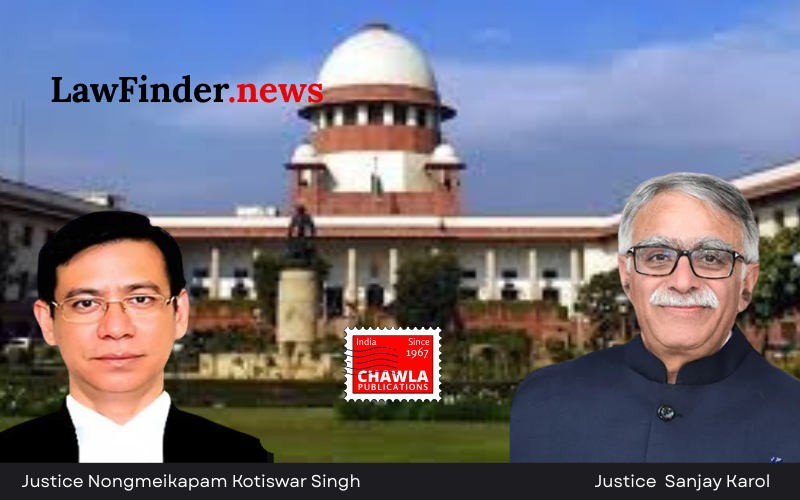
The Supreme Court reinforces the necessity of High Court approval for withdrawing prosecutions involving sitting or former MPs/MLAs, emphasizing judicial oversight in public interest.
In a significant judgment, the Supreme Court of India has upheld the decision of the Allahabad High Court which denied the withdrawal of prosecution against Bal Kumar Patel, a political figure, citing the absence of the necessary prior permission from the High Court. The case, which involved serious charges under the Arms Act and the Indian Penal Code, underscores the judicial mandate laid out in the landmark case of Ashwini Kumar Upadhyay v. Union of India.
The Supreme Court bench, comprising Justices Sanjay Karol and Nongmeikapam Kotiswar Singh, emphasized that any move to withdraw prosecution against sitting or former Members of Parliament or Legislative Assembly must first secure the approval of the High Court. This stipulation ensures that such decisions are made transparently and in alignment with public interest and justice, preventing potential misuse of executive power.
The case against Bal Kumar Patel originated from a 2007 FIR, involving charges under the Arms Act and the IPC, which alleged that Patel held an arms license in contravention of the law. Despite a government order from Uttar Pradesh in 2014 seeking to withdraw these cases, the trial court and subsequently the High Court insisted on adherence to the judicial guidelines for such withdrawals.
The Supreme Court, in its judgment, reiterated the principles governing Section 321 of the Criminal Procedure Code and Section 528 of the Bharatiya Nagarik Suraksha Sanhita, 2023. It stressed that the role of the Public Prosecutor is pivotal, requiring an independent assessment and a transparent declaration of reasons for withdrawal, which must be overseen by judicial discretion to ensure that the withdrawal serves the administration of justice.
This decision reaffirms the judiciary's commitment to maintaining the integrity of the legal process, particularly in cases involving public representatives, where the potential for political influence and misuse of power is significant. The ruling also aligns with the Supreme Court's previous directions in the Ashwini Kumar Upadhyay case, which mandates High Court scrutiny to safeguard public interest and uphold justice.
The Supreme Court's decision not only upholds the High Court's earlier ruling but also sends a strong message about the accountability mechanisms in place for prosecutorial decisions involving elected officials. This judgment is a crucial step in reinforcing the checks and balances necessary to prevent any arbitrary or politically motivated actions in the judicial process.
Bottom Line:
Withdrawal of prosecution against sitting or former MPs/MLAs requires prior permission of the High Court as per the guidelines laid down in the judgment of Ashwini Kumar Upadhyay v. Union of India.
Statutory provision(s): Section 321 CrPC, Section 528 Bharatiya Nagarik Suraksha Sanhita, 2023, Article 136 of the Constitution of India.
Bal Kumar Patel @ Raj Kumar v. State of U.P, (SC) : Law Finder Doc Id # 2817151